


KFT Food Machinery adopts CC-Link IE TSN for high-speed slicing systems
KFT Food Machinery has integrated CC-Link IE TSN industrial Ethernet technology into its slicing equipment range to support ultra-fast, multi-axis motion control in food production environments. The open industrial networking protocol, developed by the CC-Link Partner Association (CLPA), enables the company’s machines to perform up to 14 precision cuts per second whilst synchronising ten or more independently controlled servo axes.
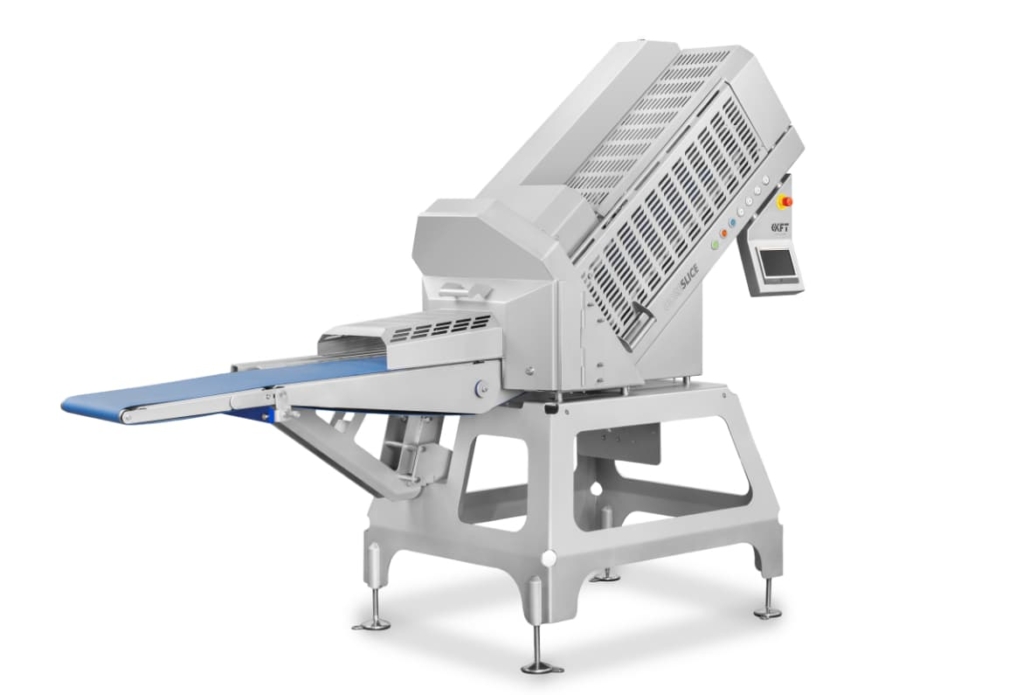
Addressing complex motion control requirements
KFT’s slicing systems operate in demanding food manufacturing facilities where equipment must maintain consistent performance across extended shifts and frequent changeovers. The technical challenge centred on coordinating multiple servo axes in real time whilst preserving system architecture integrity and maintainability.
CC-Link IE TSN’s gigabit bandwidth and Time-Sensitive Networking capabilities provide deterministic synchronisation across all axes whilst carrying both real-time control and diagnostic data on a single network infrastructure.
“The integration of a servo and motion control system supported by CC-Link IE TSN has been the definitive solution to our requirements,” says Marti Clos, CEO at KFT. “Thanks to its gigabit bandwidth, and the converged network architecture enabled by Time-Sensitive Networking, this protocol provides high transmission speed, deterministic synchronisation across all axes, and the ability to carry both real-time control and diagnostic data on the same network.”
Performance and reliability improvements
KFT’s engineering team observed measurable performance gains following implementation. The consistent, high-speed communication delivered by CC-Link IE TSN supports stable, high-precision cutting operations even at maximum speed, improving both productivity and reliability whilst reducing the risk of unplanned downtime or inconsistent results.
The network’s bandwidth and flexibility enabled KFT to simplify its control system design. By adopting CC-Link IE TSN, the company standardised its communications structure across motion control, I/O, and other peripherals, including pneumatic and safety systems. This standardisation reduced wiring and integration complexity, accelerating commissioning and ongoing technical support.
Standardisation and scalability benefits
“It allows us to simplify the communication structure, reducing complexity and setup time,” explains Marti. “We now have a future-proof foundation that supports machine scaling and expansion into new areas, like pneumatic and safety controls.”
The standardised architecture has enabled KFT to reuse motion programming code and parameters between machines, supporting product consistency and shortening development cycles.
Future implementation plans
With CC-Link IE TSN now established within its slicer architecture, KFT plans to expand the technology’s use across future designs. Beyond further integration of safety and pneumatic devices, the company sees long-term benefits in adopting a consistent, open communication backbone for all motion-driven systems.
“CC-Link IE TSN offers the performance, robustness, and flexibility we need,” says Marti. “It’s helped us push our machine capabilities forward, and it’s easy to implement and expand.”
John Browett, General Manager of the CC-Link Partner Association – Europe, commented: “It’s fantastic to see companies like KFT pushing the boundaries of machine performance by adopting CC-Link IE TSN. Seeing more and more machine builders embracing the benefits of open, high-speed industrial networking confirms just how valuable this technology is for today’s – and tomorrow’s – automation challenges.”
The CC-Link Partner Association is an international organisation founded in 2000 with 4,400 member companies worldwide. CC-Link IE TSN is described as the world’s first open industrial Ethernet combining gigabit bandwidth with Time Sensitive Networking.
- For more information, visit: www.cc-link.org