
Adapting chocolate production for the era of viral demand
As social media reshapes consumer demand at unprecedented speed, chocolate manufacturers face mounting pressure to retool production infrastructure for an era of viral trends. Brith Isaksson, Global Food and Beverage Segment Manager at ABB, investigates how variable speed drives, high-efficiency motor systems, and closed-loop process control are enabling manufacturers to achieve the industrial agility required to capitalise on fleeting market opportunities – without compromising product consistency or energy efficiency.

Brith Isaksson
One year ago, Dubai chocolate was a regional Middle Eastern speciality. Today, it is a global case study in trend-accelerated demand, resulting in countless imitators and forcing established manufacturers to rapidly reformulate products. From ruby chocolate to plant-based “superfood” bars, we have entered an era where consumer preferences shift overnight. For chocolate manufacturers, the challenge is no longer just seasonal planning. Now, it’s about building the industrial agility to capture viral windows of opportunity before they close.
According to Innova Market Insights, 28% of European consumers say they have increased their chocolate consumption because there is more variety and novelty available. Industry forecasts also estimate that the premium chocolate market will have grown by $20.8 billion between 2023 and 2028, significantly outpacing the broader chocolate market.
For manufacturers, that suggests flexibility is no longer only an operational concern, but increasingly a growth requirement. Welcome to the social media economy, where a single viral video can create demand spikes that traditional production planning never anticipated. For an industry built on predictability, this is a fundamental challenge. Equipment was invested in for specific patterns: peaks around Easter and Christmas, long production runs of established SKUs, and minimal variation. And certainly not trends that take off in a matter of days.
The mismatch creates genuine engineering challenges. How do you maintain chocolate quality when production parameters keep changing? What happens to energy efficiency when you cannot run full batches? How do you balance equipment designed for 20-year lifecycles with trends that last 20 weeks?
The hidden cost of inflexibility
Traditional chocolate production has long been optimised for efficiency at scale. But that efficiency comes with built-in inflexibility that carries costs many manufacturers are only beginning to quantify.
There is the lost revenue opportunity when viral products cannot be scaled quickly enough. By the time production ramps up, the trend may have fizzled out. Or worse, there may not be enough ingredients available, as seen with the pistachio shortage of mid-2025.
There is the equipment stress from constant changeovers between products with different viscosity, temperature requirements, and processing times. Motors designed for steady-state operation struggle with these frequent and extreme variations, and older assets are pushed beyond the torque limits of their original design. What high-pitched groans will your 15-year-old motor make when it has to process its first batch of trendy, thick, nut-filled chocolate?
There is the problem of energy waste when running chocolate conching equipment at anything other than full capacity. Traditional induction motors lose efficiency dramatically at partial loads. That can lead to quality inconsistencies when the same equipment handles products with vastly different requirements.
There is also a practical constraint often overlooked in discussions of flexibility: cleaning and allergen management. Switching between formulations can require extensive washdowns. Reducing that downtime is often just as important as the agility of the production process itself.

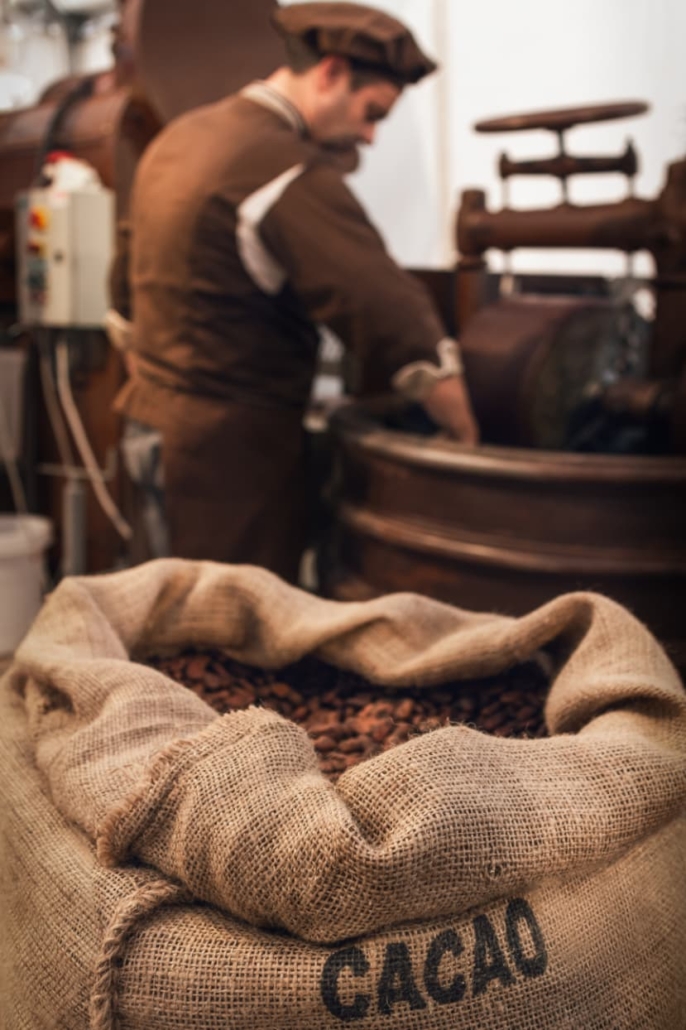
Rough conched chocolate
Variable speed: the foundation of flexibility
The solution starts with systems that maintain efficiency across wide operating ranges through the use of variable speed drives (VSDs). The key insight is that production flexibility and energy efficiency do not have to be opposing goals.
ABB’s IE5 Synchronous Reluctance motors paired with ACS880 or ACS580 drives maintain high efficiency even at 50% load and speed. This reduces utility bills, but more critically, it makes partial batches economically viable. That efficiency difference determines whether small-batch production is profitable or a loss leader.
But efficiency is only part of the equation. True production flexibility requires precise process control through real-time monitoring. Torque monitoring in the drive allows the conche to respond to changes in chocolate viscosity mid-batch, automatically adjusting for different formulations. Automated recipe handling also reduces the need for highly specialised manual tuning during changeovers, helping operators maintain consistency even as product variety increases.
In practice, true flexibility is achieved when high-performance motors and drives act as the intelligent core of the production system. By integrating with recipe management, sensors, and process monitoring, the drive becomes the execution point for rapid changeovers. It allows operators to turn data into precise mechanical action and ensure every batch meets the same exacting standard.
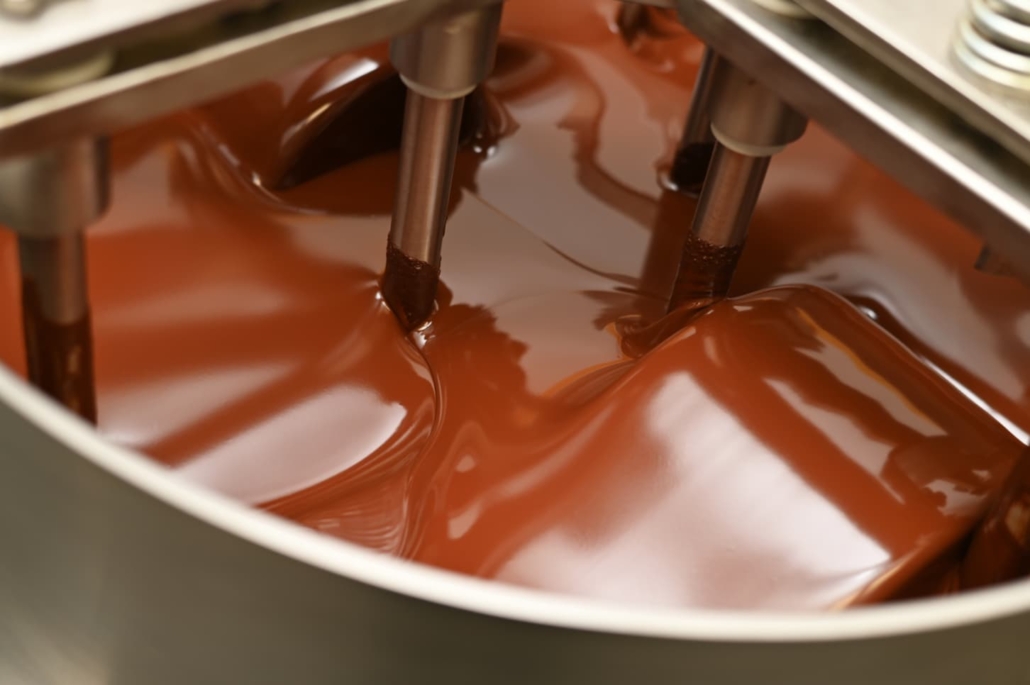
Smooth chocolate
Doubling speed for specialty products
One European chocolate manufacturer, SACMI, recently required significantly shorter conching times at higher speeds. Their existing IE3 motors could not accommodate the new levels of variation they needed without compromising efficiency.
The 2020 pandemic caused various food trends, one of them being a sudden spike (4.2%) in chocolate consumption – particularly dark chocolate, which is noted for its perceived health benefits. Dark chocolate was the main variant in SACMI’s energy efficiency analysis with ABB. For dark chocolate produced in a high-intensity cycle (approx. 7,000 hours/year), replacing IE3 motors with IE5 delivered a 3-4% saving on electric current, while reducing CO2 emissions by as much as 22 tons annually.
By retrofitting with IE5 SynRM motors and ACS880 drives in 2021, the same equipment now handles both standard products at nominal speeds and specialty products at up to 200% of original design speed. More importantly, the manufacturer could now capture opportunities that would otherwise have required dedicated equipment.
Managing variability without sacrificing consistency
Perhaps the most critical concern brought about by maximum production flexibility is quality consistency. Consumers are unforgiving – studies show that “perceived quality“ is the most important factor before purchase.
It’s essential that chocolate conches create a smooth and even blend, regardless of the size of the batch or external conditions. Modern drive technology addresses this by enabling closed-loop control, which means consistent mechanical energy input can be maintainted regardless of the amount and/or grittiness of the raw chocolate in the conche at any one time.
Data logging and analysis tools embedded in the drive can identify which parameters most affect quality, to help operators to slow, speed up, or tweak their machinery in advance of consistency problems occurring. Predictive maintenance detects bearing wear or lubrication issues well before they cascade into a bad batch.
The cleaning issue
Chocolate manufacturing environments are uniquely demanding. Equipment must withstand frequent washdowns, strict temperature control, and constant inundation with fine particles of cocoa powder – and now, the residue of other trendy fillings as well. Allergenic ingredients cannot be allowed to make it to the shelves unlabelled.
ABB’s food-grade solutions address these challenges specifically. In the Americas, Baldor-Reliance® Food Safe NEMA motors feature fully sealed and smooth stainless steel enclosures. Globally, IE5 SynRM motors are available with food-grade specifications, including the industry’s first liquid-cooled IE5 SynRM.
The liquid-cooled design eliminates the need for cooling fans that would otherwise circulate food dust. This creates a natively smooth exterior that simplifies cleaning procedures and significantly reduces washdown time during recipe or allergen-related changeovers, an important factor in maintaining agility and consumer safety when product variety increases.
The economics of adaptability
Traditional ROI calculations focus narrowly on energy savings. But this misses most of the value. Revenue capture from viral products can be enormous: bringing a trending product to market months or weeks earlier than competitors – and capturing the peak demand curve – generates revenue that dwarfs energy savings.
Risk reduction from avoiding dedicated equipment purchases is key. Flexible equipment that can pivot between products dramatically reduces the risk of expensive assets sitting idle. Efficient operation at partial loads can also help reduce the risk of overproduction when trends cool suddenly, helping manufacturers avoid excess inventory and unnecessary waste. When these factors are included, payback periods that looked like 2-3 years based on energy alone might shrink to 6-12 months.
Permanent agility
The Dubai chocolate trend will pass. But the expectation for rapid innovation will not. Consumer behavior has become permanently less predictable, compressing product lifecycles from years to months.
Ultimately, agility is the result of a complete production ecosystem, combining motors, drives, automation, process control, and data insights to support faster innovation without sacrificing consistency.
The manufacturers who thrive will be those who have built the right infrastructure to respond not just to today’s viral chocolate product – but to whatever goes viral next.