
Biosynthetic breakthrough enables efficient tagatose production from glucose
Researchers have engineered E. coli bacteria to produce the low-calorie sweetener tagatose directly from glucose with yields up to 95%, potentially transforming commercial production of this rare sugar. The method reverses a natural metabolic pathway using a newly characterised enzyme from slime mould.
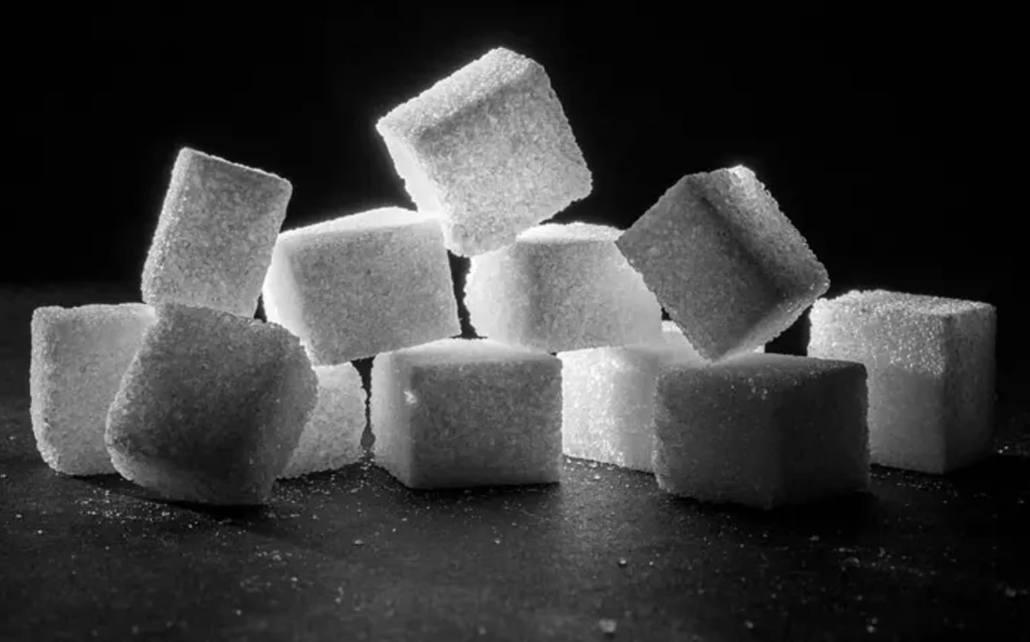
Unlike sucrose (shown here), tagatose has 60% fewer calories, a limited effect on blood sugar due to delayed metabolism in the colon, and may benefit healthy gut and oral bacterial environments. © Dietmar Rabich – CC by SA 4.0
Scientists at Tufts University have developed a biosynthetic method to produce tagatose, a rare natural sugar with significant potential as a healthier alternative to sucrose, by engineering Escherichia coli to convert abundant glucose directly into the sweetener. The research, published in Cell Reports Physical Science, demonstrates yields reaching approximately 95% compared to conventional chemical processes that achieve only 40-77%.
Discovery of enzyme enables pathway reversal
The breakthrough centres on the identification and characterisation of a galactose-1-phosphate-specific phosphatase (Gal1Pase) from the slime mould Dictyostelium discoideum. This enzyme proved crucial in reversing the Leloir pathway, which normally metabolises galactose to glucose in bacterial cells.
“We developed a way to produce tagatose by engineering the bacteria Escherichia coli to work as tiny factories, loaded with the right enzymes to process abundant amounts of glucose into tagatose,” said Nik Nair, associate professor of chemical and biological engineering at Tufts. “This is much more economically feasible than our previous approach, which used less abundant and expensive galactose to make tagatose.”
The authors note in their paper that current production methods are limited, “often relying on galactose isomerisation, and remain inefficient and costly.” Traditional approaches using lactose-derived galactose suffer an inherent 50% carbon loss since lactose consists of both glucose and galactose, with only the galactose portion convertible to tagatose.
Technical approach and enzyme specificity
The engineered E. coli strain incorporates multiple genetic modifications including deletion of pgi (phosphoglucose isomerase) to prevent glucose entering glycolysis, and galK (galactokinase) to block rephosphorylation of galactose. The DdGal1Pase enzyme provides the thermodynamic driving force by selectively dephosphorylating galactose-1-phosphate (Gal1P), shifting equilibrium towards reverse Leloir pathway flux.
Computational analyses using molecular dynamics simulations, quantum mechanics/molecular mechanics calculations, and well-tempered metadynamics revealed the molecular basis for the enzyme’s stringent substrate selectivity. The research showed that DdGal1Pase exhibits remarkable specificity for Gal1P over the structurally similar glucose-1-phosphate (G1P), despite the molecules differing only in C4 hydroxyl stereochemistry.
A second enzyme, L-arabinose isomerase from Bacillus coagulans, completes the conversion pathway by isomerising galactose to tagatose. The authors demonstrated that cultures produced approximately 10.5 g/L galactose from 30 g/L glucose (35% yield) and more than 1 g/L tagatose without substantial optimisation.
Advantages for food applications
Tagatose offers several functional and nutritional advantages for food manufacturing. With 92% the sweetness of sucrose but only 40% of the calories, it provides bulk sweetening properties that high-intensity sweeteners cannot match. The sugar browns during cooking similarly to sucrose, enabling its use in baked goods and other applications requiring Maillard reactions.
“Tagatose is 92% as sweet as sucrose – table sugar – and has about 60% fewer calories,” noted the researchers. The compound has received “generally recognised as safe” (GRAS) designation from the US Food and Drug Administration, placing it in the same regulatory category as salt, vinegar and baking soda.
The sugar’s metabolism differs substantially from sucrose. Only partially absorbed in the small intestine, much of the tagatose undergoes fermentation by gut bacteria in the colon, resulting in minimal impact on blood glucose and insulin levels. Clinical studies demonstrate very low increases in plasma glucose or insulin following tagatose ingestion, offering particular benefits for diabetic consumers.
Industry implications and future development
The theoretical maximum pathway yield of 94.9% represents a significant improvement over lactose-based production routes. The authors acknowledge that whilst galactose production from glucose is efficient, “galactose is produced at higher titres than tagatose, with tagatose appearing as a minor product (∼1 g/L).”
The research team suggests several avenues for optimisation, including thermostable isomerase variants for higher-temperature operation to improve galactose-to-tagatose equilibrium, and engineering of cellular transport systems. Deletion of the putative sugar transporter gene ydeA showed a 1.66-fold increase in tagatose production.
Beyond tagatose production, the platform technology offers potential for synthesising other rare sugars and galactose-derived molecules directly from glucose. The unique substrate specificity of DdGal1Pase could serve as a model for rational design of phosphatases for alternative rare sugar pathways, including allulose production.
The authors conclude that whilst “further optimisation is required to improve tagatose production, this strategy eliminates dependence on lactose-derived galactose and provides a framework for scalable, glucose-based biosynthesis of tagatose and other galactose-derived molecules, supporting sustainable rare-sugar production.”
Reference
Love, A. M., Toomey, C. G., Kumar, A., et. al. (2025). Reversal of the Leloir pathway to promote galactose and tagatose synthesis from glucose. Cell Reports Physical Science, 6, 102993. https://doi.org/10.1016/j.xcrp.2025.102993