Fraunhofer develops portable sensor system for rapid food fraud detection
Three Fraunhofer institutes are collaborating on a mobile gas chromatography sensor system designed to identify counterfeit food products directly at the point of inspection. The shoulder bag-sized device aims to enable non-specialists to perform rapid authenticity assessments without the need for laboratory analysis.
The PUMMEL project (Point-of-use micro-multichannel gas chromatograph), funded through the Fraunhofer PREPARE programme, brings together researchers from the Fraunhofer Institutes for Photonic Microsystems (IPMS), Molecular Biology and Applied Ecology (IME), and Process Engineering and Packaging (IVV). The project runs from March 2023 to August 2026.
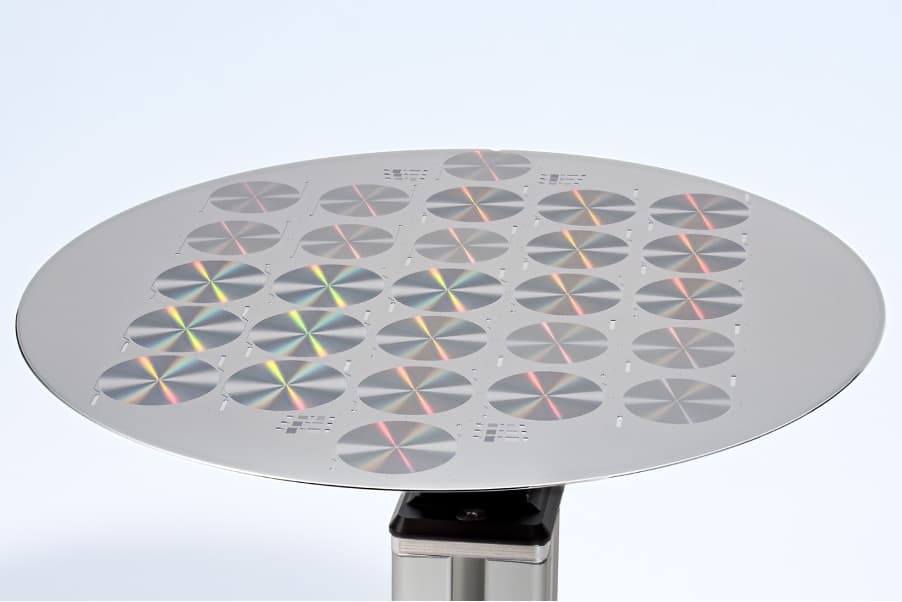
Micro-gas chromatography columns (µGC columns) etched into a 200-mm silicon wafer. The columns are sealed with a second wafer using a wafer-bonding process and then separated. They are subsequently coated with a stationary phase, similar to conventional GC columns. © Fraunhofer IPMS
Targeting two key applications
The research team is focusing on two industrially relevant use cases: identifying counterfeit olive oil, which ranks among the ten most frequently adulterated food products globally, and detecting contaminated plastic recyclates in packaging materials.
“There’s a clear need for cost-efficient, rapid and robust on-site measurement technology that yields immediate results,” said Olaf Hild, Head of Department at Fraunhofer IPMS. “Our system isn’t universal, but its modular design makes it suitable for a broad range of applications.”
Mark Bücking, Head of Department at Fraunhofer IME, added: “We’re aligning industrial interests with scientific challenges, with a focus on technological innovation that serves the German and European economies.”
How the technology works
The portable system comprises a silicon-chip-based gas chromatography column, detector, integrated sample preparation, control electronics and power supply. Gas chromatography separates, identifies and quantifies mixtures of volatile organic compounds (VOCs), which provide information about a product’s composition and potential quality issues.
A carrier gas transports samples through the miniaturised GC column, which is etched into a rapidly heatable and coolable silicon chip. VOCs interact with the polymer-coated inner walls according to their chemical affinity, enabling separation. A detector then measures the separated substances, generating a chromatogram that reveals the mixture’s composition.
For olive oil analysis, the system aims to determine parameters including country of origin, age and purity level.
Testing progress and target users
Initial tests using a conventional three-metre GC column have demonstrated reliable VOC separation and effective sample analysis. While laboratory gas chromatographs typically use columns exceeding 30 metres for maximum separation efficiency, the researchers note this level is unnecessary for most food quality assessments.
“With our system we’re targeting non-specialists, such as bottlers and incoming-goods inspectors, who can easily operate the device after a short briefing,” said Tilman Sauerwald, a researcher at Fraunhofer IVV. “The components of our system can be adapted for specific applications, making it suitable for quality control in a range of different contexts, including the analysis of recycled plastics.”
Fraunhofer at Analytica trade fair in Munich
The research team will present project results at the Analytica trade fair in Munich from 24–27 March 2026, at the Fraunhofer joint stand in Hall 3, Stand 312.
- For more information, visit: www.ipms.fraunhofer.de