Munson Machinery rotary batch mixer enables precise multi-stage coating in nutraceutical production
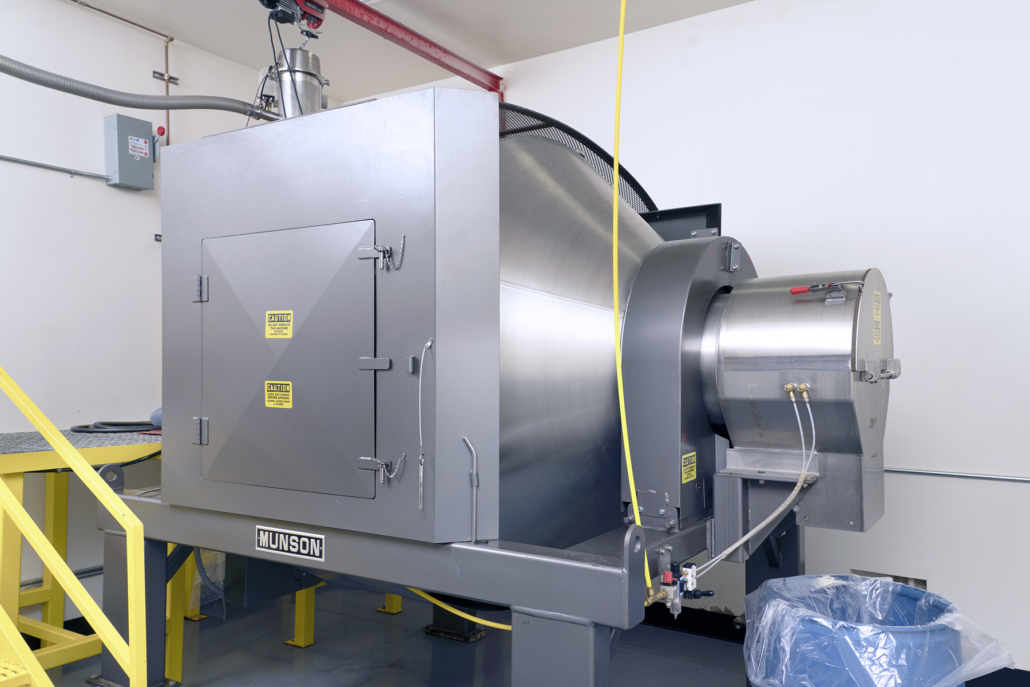
Nutraceutical Research Sciences, LLC (NRS), a private-label manufacturer of nutraceuticals and novel ingredients, has built its manufacturing capability around a model 700-TS-50-SS Rotary Batch Mixer from Munson Machinery. The company produces a wide range of products – from anti-aging supplements and sports nutrition to vitamins and meal replacements – using proprietary processes that depend on precise control of mixing conditions.
Liquid additions and environmental control
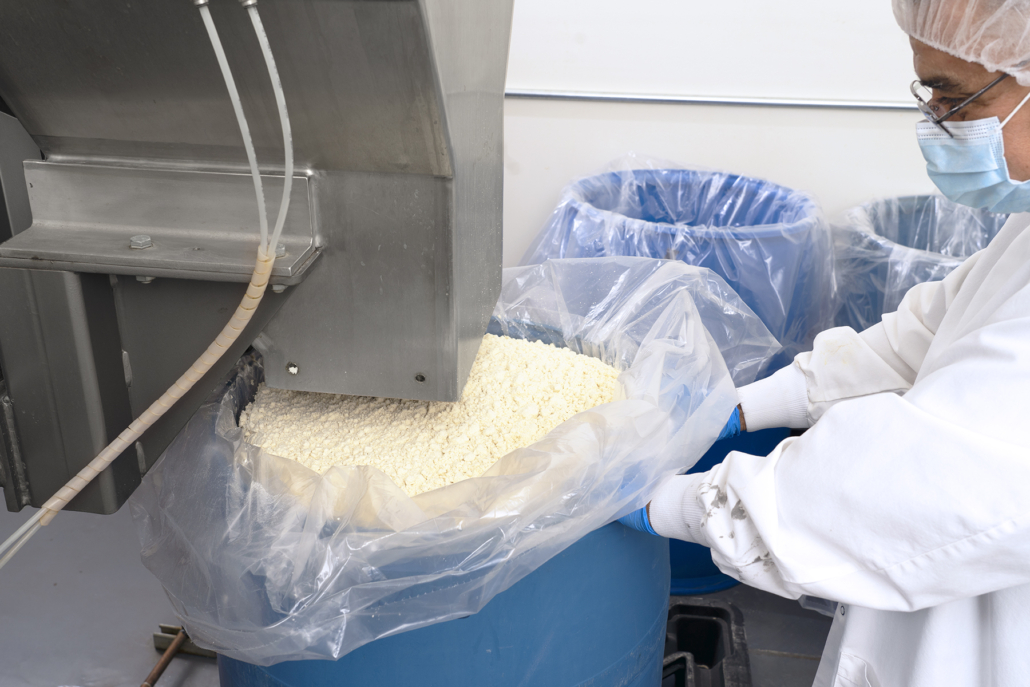
Most batches involve one or more liquid additions, introduced into the 1,416 L (50 cu ft) mixer vessel through internal spray bars fitted with exchangeable tips. The system accommodates aqueous and oil-based liquids by the litre or millilitre, and can also deliver liquids as a fine vapour. The spray bars operate in conjunction with subsystems for heating, cooling, dehumidifying and pressurising the vessel – giving operators, in the words of NRS founder John Anderson, “full control over how we process each product.”
A dehumidifier connected to the mixer removes moisture from the vessel between liquid addition stages, enabling sequential liquid coatings. Anderson contrasted this with V-blender technology: “It’s much easier than with a V-blender because you have to exchange the air on the fly. The exhaust air will pick up a lot of material, and you’ll have a huge loss.” The rotary mixer’s gentle tumble-turn-cut-fold action minimises dusting, and a single drum seal prevents dust leakage.
Particle sizing and blend uniformity
Matching particle sizes is central to NRS’s formulation work. By applying controlled humidity during mixing, the company can combine materials of significantly differing particle sizes – such as 841 micron (20 mesh) and 149 micron (100 mesh) fractions – and then dry them whilst mixing, without segregation. Blend uniformity extends to minor ingredients: when encapsulating chromium picolinate at 100 micrograms per two-piece capsule, Anderson reported that “the mixer’s uniform blending enabled us to hold it to within just two micrograms either way of hitting 100 micrograms per capsule.”
Cycle times, discharge and scale-up
The mixer’s inlet and outlet remain stationary while the drum rotates, permitting hard-piped connections to upstream screw conveyors or pneumatic conveying cyclone separators. Continuous drum rotation during loading and unloading reduces cycle times and prevents ingredient segregation on discharge. NRS currently achieves four to eight batches per eight-hour shift. To meet growing demand, the company is adding a Munson model 700-TS-90-SS with a capacity of 2,549 L (90 cu ft), designated ‘Genesis 2’, with a further 8,495 L (300 cu ft) unit – ‘Genesis 3’ – under consideration for larger-volume blending.
Between batches, large access doors allow steam cleaning and sanitisation of the interior, verified by swab tests. Anderson noted that the dedicated installation makes cleaning considerably simpler than working around a mezzanine-mounted V-blender.
For more information, visit: www.munsonmachinery.com
Digital issue: Please click here for more information