Sunflower seed flour byproduct yields high-protein, antioxidant-rich functional breads
Brazilian researchers have demonstrated that partially defatted sunflower seed flour – a widely overlooked byproduct of industrial oil extraction – can be incorporated into bread formulations to significantly enhance protein content and antioxidant activity. Critically, an aqueous extract of the flour preserves the rheological properties associated with conventional wheat bread, offering a viable route for commercial application.
Partially defatted sunflower seed flour (SF) contains between 40% and 66% protein (w/w), alongside dietary fibre, iron, calcium, and high concentrations of chlorogenic acid – a phenolic compound associated with anti-oxidant, anti-inflammatory, and hypoglycaemic effects. Despite this nutritional profile, SF is routinely sold off cheaply by the sunflower oil industry to avoid disposal as waste. A new study published in ACS Food Science & Technology by Mesquita and colleagues at the University of Campinas and the Federal University of São Paulo demonstrates the systematic optimisation of SF as a partial wheat flour (WF) substitute in bread production.
Formulation and proximate composition
Eight bread formulations were prepared by replacing WF with SF at proportions ranging from 10% to 60% (w/w), alongside a control formulation incorporating an aqueous extract of SF (SFE) into a 100% WF dough. Proximate analysis confirmed a consistent increase in protein, fat, ash, and total dietary fibre as SF content rose. The 60% SF formulation achieved 27.16% protein – more than triple the 8.27% recorded in the 100% WF control. Available carbohydrate content fell markedly across SF-containing formulations, from 51.88 g per 100 g in the control to 6.29 g per 100 g at 60% SF substitution.
The SFE formulation (100WF:SFE) delivered a protein content of 12.23% and an available carbohydrate value of 48.29 g per 100 g, closely matching the control’s macro-nutrient profile whilst delivering substantially enhanced bioactive compound concentrations.
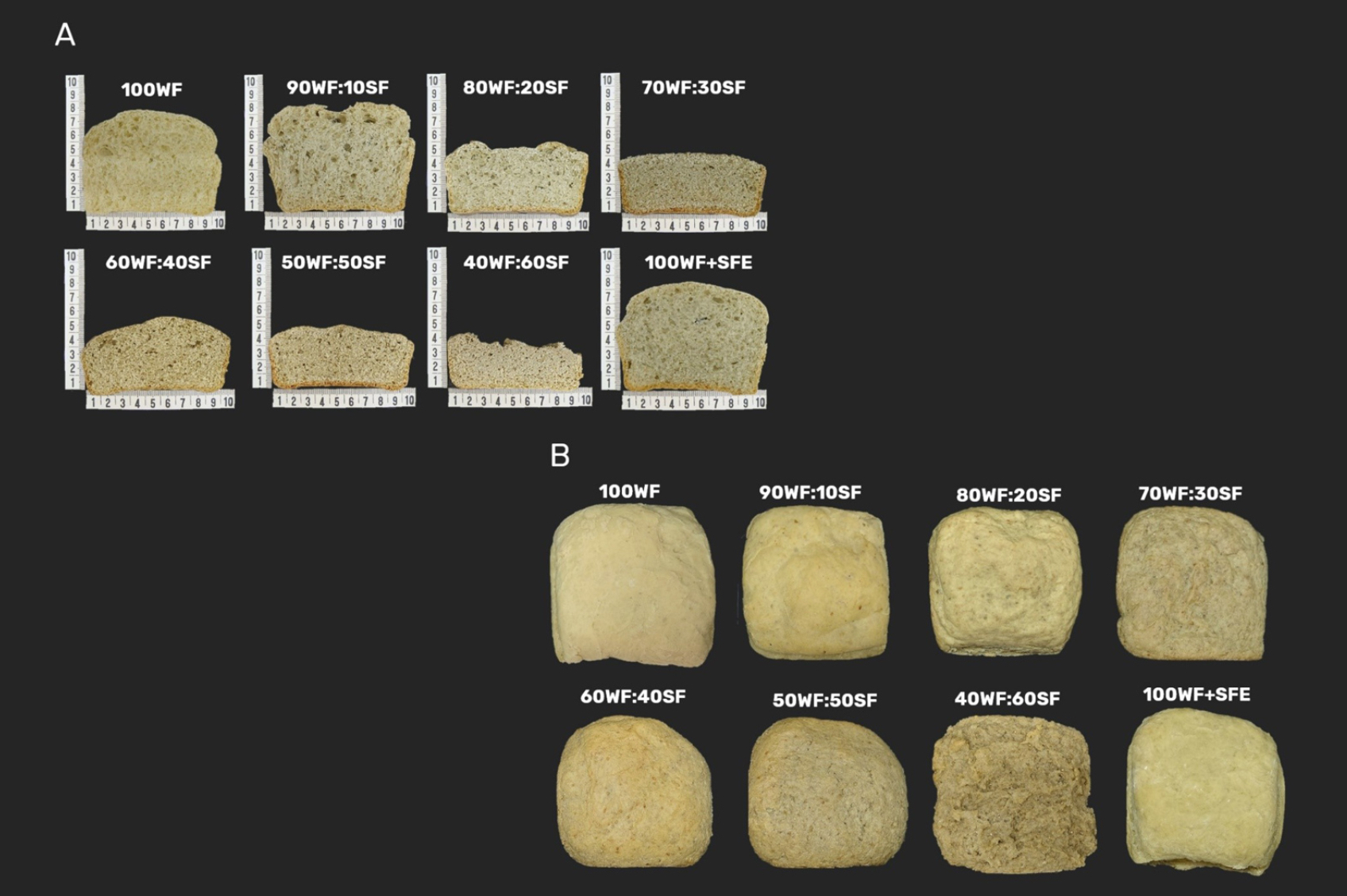
Bread formulated with different proportions of wheat flour (WF) and sunflower seed flour (SF), as well as bread with added aqueous extract of sunflower seed flour (SFE). Photos of the slices are in A, and photos of the surfaces/crusts are in B.
© Leonardo Mendes de Souza Mesquita
Chlorogenic acid stability and antioxidant activity
Chlorogenic acid (CA) content increased proportionally with SF inclusion and was found to remain stable through baking, with a slight post-bake increase attributed to isomerisation under thermal conditions. The SFE formulation achieved the highest CA concentration – 51.02 mg chlorogenic acid g-¹ more than the highest SF-containing bread (40WF:60SF).
Antioxidant activity, measured via the ABTS radical scavenging method and expressed as Trolox equivalent antioxidant capacity, increased progressively with SF content, peaking at 995.0 ± 22.1 µmol Trolox g-¹ bread in the SFE formulation. A near-perfect Pearson correlation (R = 0.9918, p < 0.0001) confirmed that chlorogenic acid is the primary driver of this antioxidant effect.
Enzyme inhibition and metabolic relevance
The SFE formulation exhibited the highest inhibitory activity against α-amylase (92.81%) and pancreatic lipase (25.6%). The authors note that these findings “highlight promising opportunities for developing functional breads aligning with a circular economy approach,” with CA derivatives identified as the principal bioactive agents responsible for these effects. Such inhibitory properties are of interest in the context of managing postprandial glycaemia and dietary lipid absorption.
Physical properties and dough rheology
Replacing more than 10% WF with SF compromised physical bread quality. From 20% SF onwards, loaf-specific volume decreased, crumb and crust firmness increased, and alveolar structure became denser and more compact – attributable to the dilution of wheat gluten and reduced starch gelatinisation capacity, as reflected in Mixolab thermomechanical parameters.
The SFE formulation circumvented these limitations. As the authors note: “The rheological attributes are comparable with those of control breads formulated with wheat flour.” Multiple factor analysis confirmed that the SFE bread clustered with the 100% WF control and the 10% SF formulation, separate from higher-SF blends which showed significant structural deterioration.
Circular economy implications
Lead author Leonardo Mesquita highlights the broader sustainability case: “Transforming waste into products is a fundamental strategy for promoting a circular economy and reducing resource waste. As well as being a cheap raw material, partially defatted sunflower seed flour contributes to human health and environmental sustainability. It therefore covers the three pillars of the circular economy: economic, social, and environmental.”
The authors identify scale-up and shelf-life stability as priorities for future investigation, alongside consumer sensory evaluation – essential steps before industrial adoption.
Reference
Mesquita, L. M. de S., Aguiar, E. V., Contieri, L. S., et. al. (2025). Repurposing sunflower seed flour for nutritional and functional high-protein breads within a circular economy framework. ACS Food Science & Technology, 5, 1425–1435. https://doi.org/10.1021/acsfoodscitech.4c01008