
Plant-based dairy alternatives: review highlights fortification gaps and fermentation opportunities for food manufacturers
A comprehensive review published in European Food Research and Technology synthesises the current state of plant-based milk and fermented dairy alternatives, identifying substantial variability in nutritional composition across product categories and signalling clear formulation, fortification and processing priorities for the food manufacturing sector seeking to close the quality gap with conventional dairy.
Industry implications: fortification, formulation and process optimisation
For food scientists and product developers, the review by Kulaksız Gunaydı and Cakmak Kafadar of Kırklareli University delivers an unambiguous message: most commercial plant-based dairy alternatives (PBDAs) currently underdeliver on key nutrients relative to cow’s milk, and the industry’s response must be more systematic. The authors note that cow’s milk provides approximately 3.0-3.5 g of protein and roughly 120 mg of calcium per 100 g, whereas most plant-based alternatives fall short of these benchmarks. This compositional shortfall has direct implications for fortification strategy, labelling claims and regulatory positioning, particularly in the European Union and Canada where dairy descriptors are restricted.
The authors note in their abstract: “Compared with cow’s milk, which provides approximately 3.0-3.5 g of protein and about 120 mg of calcium per 100 g, most plant-based alternatives contain lower levels of these nutrients, highlighting the need for fortification, particularly with calcium, iodine, and vitamin B12.”
The commercial scale of the deficit is striking. The review cites Australian market data showing only a small proportion of 115 plant-based milk products had undergone mineral fortification, with none directly fortified with iodine. European market analysis indicated only 13% of plant-based beverages and yoghurt alternatives were iodine-fortified, while a Norwegian study found most of 40 analysed products had iodine levels below the limit of detection. The overall iodine content of plant-based milk alternatives is reported as 98.4% lower than that of cow’s milk.
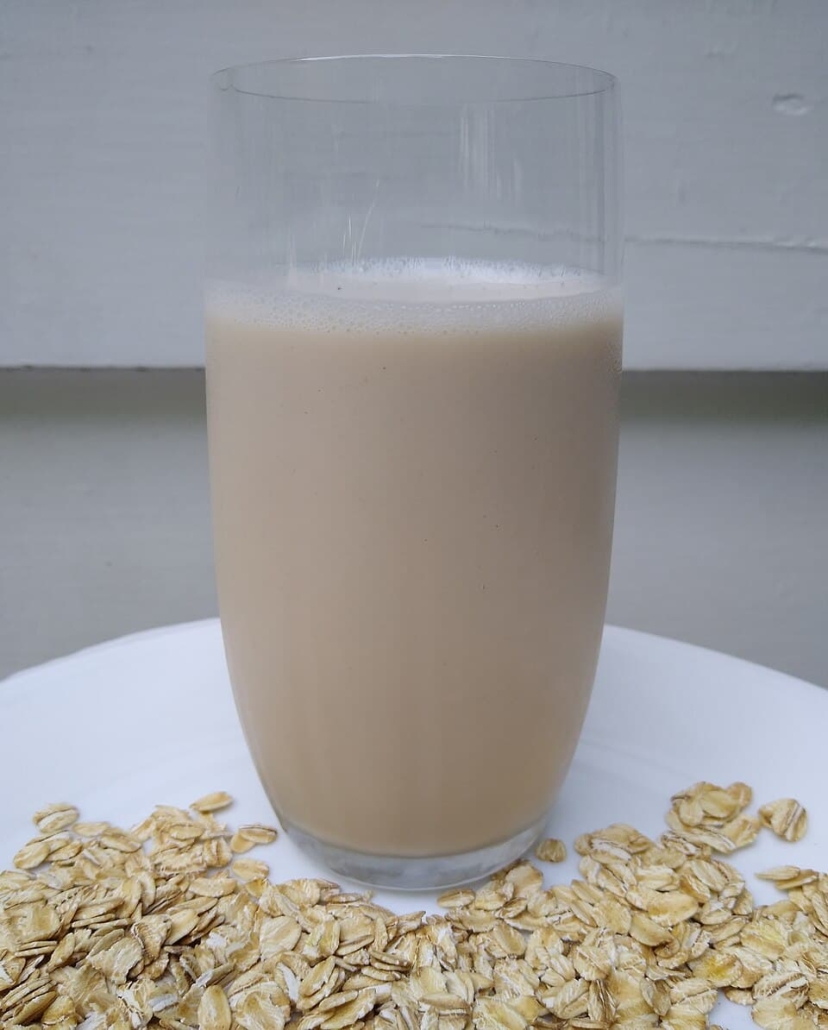
oatmilk
Compositional variability across plant matrices
The review classifies PBDAs by raw material source – cereals (oat, rice), legumes (soy), nuts (almond, hazelnut) and seeds (sunflower) – and documents wide compositional spread. Per 100 g, oat milk delivers approximately 66 kcal, 0.97 g protein and 8 mg calcium; soy milk provides 43 kcal, 3.40 g protein and 9 mg calcium; almond milk contributes 57.36 kcal, 2.36 g protein and 16.01 mg calcium; rice milk supplies 52.03 kcal, 3.14 g protein and 157.3 mg calcium; and hazelnut milk offers 73 kcal, 2.43 g protein and 32.5 mg calcium.
Soy is the only category that approaches cow’s milk protein content. The review cites clinical evidence from a systematic review of randomised controlled trials indicating that replacing cow’s milk with soy milk is associated with reductions in LDL and non-HDL cholesterol, lower systolic and diastolic blood pressure, and decreased C-reactive protein levels.
Processing trade-offs in oat milk production
Oat milk production illustrates the technological tension between sensory quality and functional value. Enzymatic hydrolysis using amylase, cellulase and β-glucanase improves texture and processability, but the authors caution that “certain enzymatic treatments may reduce native bioactive compounds such as β-glucan, indicating that improvements in sensory quality may occur at the expense of functional value.” Optimisation of upstream steps – soaking time, for instance – emerges as a practical lever; an 8-hour soak prior to milling yielded the most favourable physicochemical results in one cited trial.
The oat pulp by-product, rich in soluble and insoluble dietary fibres, phenolic compounds and β-glucan, is identified as an underexploited resource for food enrichment applications.
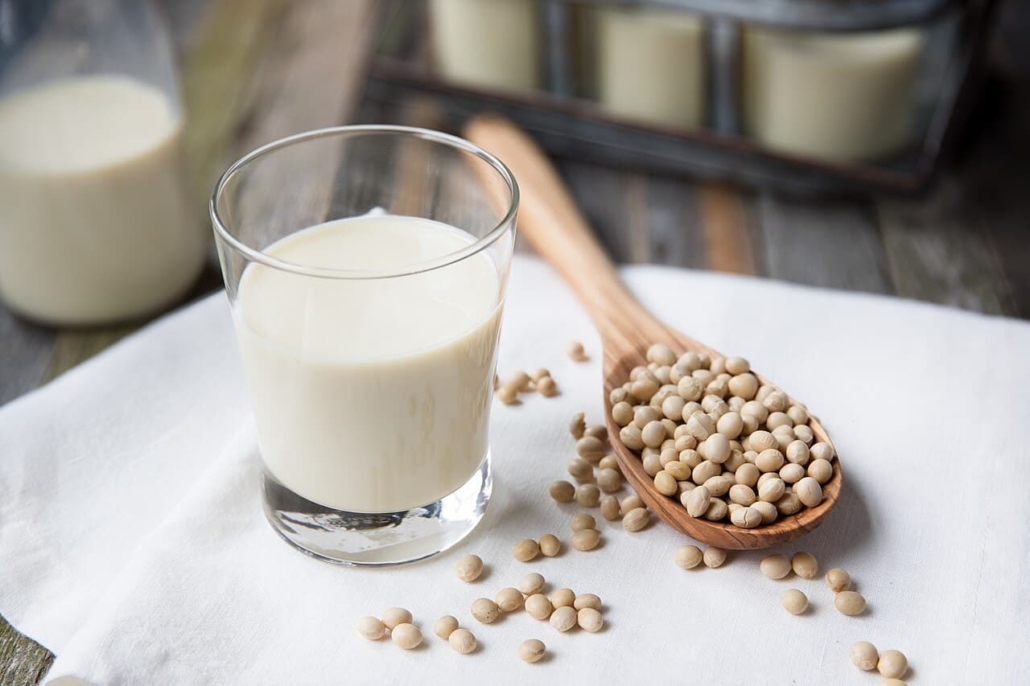
soymilk credit: CC: Kjokkenutstyr.net
Soy milk: balancing antinutritionals and sensory defects
Soy processing presents a parallel challenge. Post-extraction heat treatments are preferred because they exert less impact on protein solubility, but heat is essential for controlling beany flavours via lipoxygenase inactivation and for reducing trypsin inhibitor activity. The review notes that fermentation, NaCl addition and epigallocatechin gallate have all been reported as effective in reducing trypsin inhibitor activity, giving formulators multiple tools beyond thermal treatment alone.
Fermentation: tailored, not uniform
Fermentation is positioned as a central enabling technology, but the authors are explicit that benefits are not universal. They note: “Fermentation does not improve protein digestibility in all plant-based milks to the same extent. Its impact depends on the raw material used, the microbial culture, and the processing conditions. While fermentation can increase protein solubility and peptide release in some formulations, in others the nutritional improvement remains limited, indicating that fermentation strategies should be tailored to specific formulations rather than applied uniformly.”
Plant-based kefir and yoghurt analogues
For plant-based kefir, the review documents that water kefir grains struggle to maintain microbial viability in some substrates – traditional kefir grains were unable to maintain viability in quinoa medium, whereas Lactiplantibacillus plantarum achieved high viability while enhancing phenolic compounds and protein hydrolysis. Spirulina platensis enrichment in soy- and almond-based kefirs improved lactic acid bacteria viability, antioxidant capacity and rheological properties.
For yoghurt analogues, structural deficits driven by low protein content and limited gel-forming capacity have driven additive use. Low-acyl gellan gum at 0.1% raised water-holding capacity to 96% in soy-based formulations; tapioca starch at 1% optimised coconut milk yoghurt acceptance; hemp protein at 10% provided the most balanced texture, water-holding capacity and flavour outcomes. High-pressure processing of mung bean, chickpea, pea, lentil and faba bean proteins yielded gels with viscosity and elasticity comparable to dairy yoghurts.
Cheese analogues: the casein problem
The review identifies replicating casein functionality as the central technical barrier in plant-based cheese. A U.S. market evaluation found only 3% of 245 cheese alternatives contained adequate protein levels, with the majority based on coconut oil, cashew and starch. Thermal gelation approaches using soy protein isolate with coconut oil and tapioca starch, and zein-based formulations at 30% inclusion, are highlighted as promising routes to meltability and stretchability comparable to cheddar.
Emerging technologies and AI-driven formulation
Beyond UHT, the review surveys non-thermal preservation options – high-pressure processing, high-pressure homogenisation, ultrasound and pulsed electric fields – alongside extrusion, which has been shown to improve protein content and digestibility while reducing antinutritional compounds in common bean-based beverages. Microencapsulation is documented as a viable route to maintain probiotic viability without compromising sensory properties.
The authors also flag artificial intelligence and machine learning as data-driven tools for sensory optimisation and formulation prediction, enabling rapid integration of compositional, processing and sensory data.
Outlook for the sector
The authors conclude: “Plant-based milk and fermented dairy alternatives hold significant potential as substitutes for conventional milk and dairy products, both in terms of health and environmental sustainability… However, compared to cow’s milk, plant-based alternatives are often lacking in certain essential nutrients such as protein, calcium, and iodine, making fortification necessary. Fermentation stands out as a critical process for enhancing the nutritional and functional quality of these products, reducing antinutritional compounds, and imparting probiotic properties. Nevertheless, technical challenges related to structural stability, texture, and sensory quality require formulation and process optimisation.”
The authors acknowledge that variability in raw materials, pre-treatment, processing technologies and analytical methods complicates direct cross-study comparisons, and that many reported health effects derive from in vitro or short-term studies, underscoring the need for long-term human trials.
For food manufacturers, the practical agenda is clear: targeted fortification with calcium, iodine and vitamin B12; matrix-specific fermentation strategy; valorisation of fibre- and protein-rich processing by-products; and continued investment in non-thermal and gelation technologies to close the textural gap with conventional dairy.
Reference
Kulaksız Gunaydı, Z. E., & Cakmak Kafadar, G. (2026). Plant-based dairy alternatives: comprehensive insights into technology, functionality, nutrition and health. European Food Research and Technology, 252(189). https://doi.org/10.1007/s00217-026-05122-8