
Non-GM yeast mutation boosts ornithine levels in craft beer nine-fold, study finds
Scientists at Nara Institute of Science and Technology and Iwate University have isolated a wild yeast mutant carrying a single point mutation in the ARG6 gene, raising intracellular ornithine levels up to nine-fold without genetic modification or loss of fermentation performance, opening a route to functional craft beer production.
Non-GM breeding route offers value-added brewing opportunity
Brewers and functional beverage manufacturers now have a validated, non-genetically modified route to enriching fermented beverages with ornithine, a nonproteinogenic amino acid associated with fatigue reduction, ammonia detoxification and sleep support. Researchers at the Nara Institute of Science and Technology (NAIST) and Iwate University have published findings in the Journal of Industrial Microbiology and Biotechnology describing a wild yeast strain, isolated from a university campus environment, that was bred – rather than gene-edited – into a high-ornithine producer through classical mutagenesis and selective screening.
For food scientists and brewers, the implications are immediate: the mutation can be introduced into existing industrial yeast backgrounds, including ale, lager, wine and sake strains, without compromising fermentation kinetics. As the authors put it in their paper’s abstract, the work establishes “a practical nongenetically modified breeding strategy for enhancing ornithine production in yeast, which will facilitate the development of ornithine-enriched fermented beverages such as craft beer.”
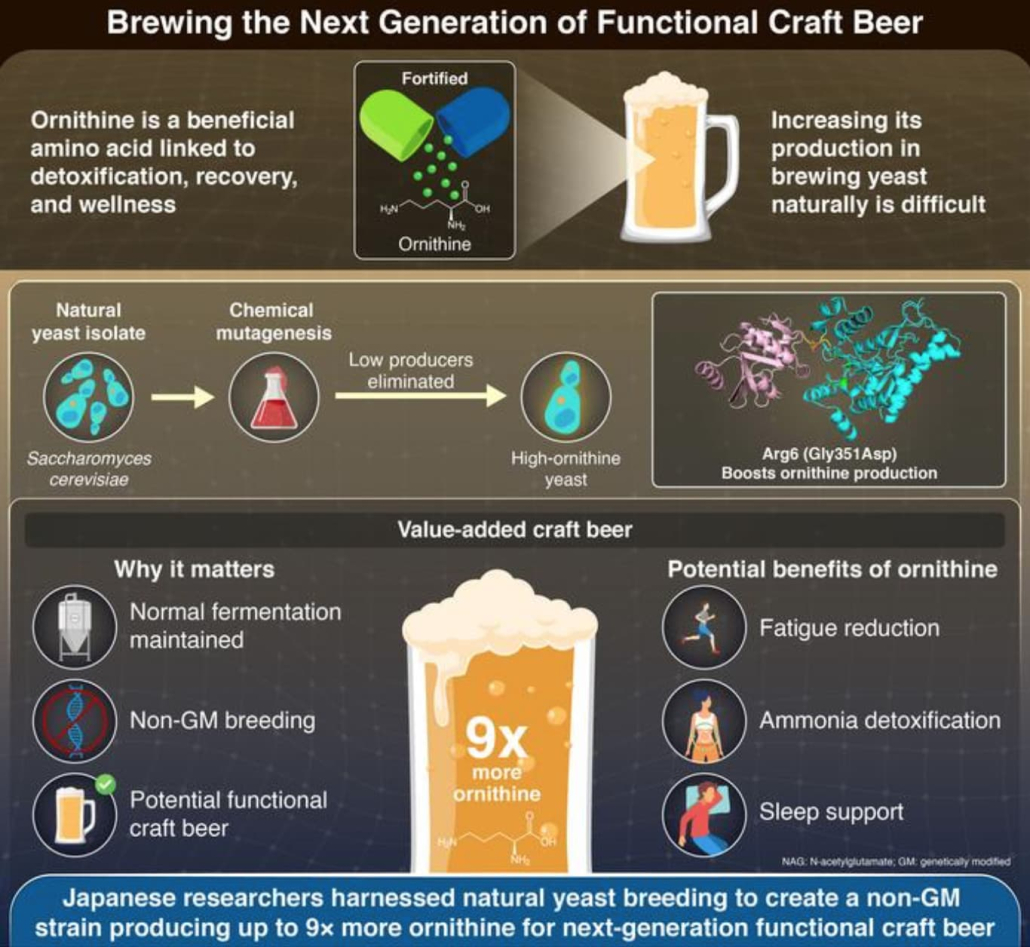
Japanese researchers developed a nongenetically modified (non-GM) yeast that naturally produces 9× more ornithine, paving the way for functional craft beer. © Professor Hiroshi Takagi from Nara Institute of Science and Technology, Japan, and Professor Akira Nishimura from Iwate University, Japan.
Isolating the high-producing mutant
The research team, led by Professor Hiroshi Takagi of NAIST together with Associate Professor Akira Nishimura (now at Iwate University), Assistant Professor Shota Isogai and Dr Ryoya Tanahashi, began with strain ADH837, a wild Saccharomyces cerevisiae isolate already used commercially by 10 Fields Factory Co., Ltd. Rather than applying gene editing, the team used ethyl methanesulfonate (EMS) chemical mutagenesis followed by selection on canavanine, a toxic arginine analogue, to enrich for mutants with altered arginine metabolism.
From 534 canavanine-resistant clones, one mutant – designated ADHorn49 – stood out with intracellular ornithine levels more than nine-fold higher than the parental strain. According to the press release, this “wild yeast discovery enables non-GM brewing of ornithine-enriched craft beer” by exploiting a naturally occurring genetic change rather than an engineered one.
Pinpointing the ARG6 mutation
Whole-genome sequencing of ADHorn49 revealed 327 missense mutations, but only one heterozygous G→A transition, in the ARG5,6 gene, was identified as the likely driver. This causes a Gly351Asp substitution in Arg6 (N-acetylglutamate kinase), a highly conserved residue sitting in the linker region between the enzyme’s catalytic AAK domain and its fungal-specific domain.
Introducing the mutated allele into multiple industrial strains – including a laboratory strain, an ale strain, a wine strain and a sake strain – consistently raised intracellular ornithine, confirming the mutation alone is sufficient to drive the phenotype. Systematically substituting all 19 alternative amino acids at position 351 also increased ornithine accumulation in every case, with only Gly351Phe outperforming Gly351Asp. The authors conclude this indicates that “Gly351 functions as a negative regulatory site in Arg6, likely involved in arginine-mediated feedback inhibition.”
Structural basis for deregulation
Structural modelling using SWISS-MODEL and AlphaFold suggested the substitution introduces new hydrogen-bonding networks linking the AAK domain and the fungal-specific domain, potentially stabilising a conformation less sensitive to arginine feedback inhibition. The team also modelled the Arg2–Arg6 complex, predicting that Arg6 interacts with Arg2 through both domains, and proposing that the mutation may work by attenuating feedback inhibition and/or stabilising this complex.
Fermentation performance unaffected
Critically for brewers, the mutation did not compromise industrial usability. In wort fermentation trials, carbon dioxide production profiles for ADHorn49 and the parental strain were largely indistinguishable, with only a small, transient difference in the early stages. Intracellular ornithine rose 3.5-fold and extracellular ornithine reached 52.7 nmol/mL, equivalent to 7.0 mg/L free ornithine, after 96 hours of static fermentation – within the range reported for some ornithine-containing foods.
As the paper’s discussion notes, “enhanced ornithine production does not compromise fermentation performance, highlighting the suitability of strain ADHorn49 for brewing applications.” The infographic accompanying the release states that the approach maintains “normal fermentation” while enabling “non-GM breeding” and “potential functional craft beer.”
Wider industry significance
Beyond beer, the researchers position ADHorn49 as a platform strain for future metabolic engineering toward other ornithine-derived bioactive compounds, such as polyamines. Professor Nishimura commented that “valuable microorganisms can still be discovered from local natural environments,” underlining the continued relevance of biodiversity screening to fermentation science. Professor Takagi added that the study “clearly demonstrates a practical non-genetically modified strategy that combines traditional microbial breeding with molecular understanding,” adding that the team hopes “to support the development of value-added fermented foods and beverages.”
In their concluding remarks, the authors state the work “identifies a previously unrecognized regulatory site in yeast ornithine metabolism” and offers “a practical and scalable strategy for producing ornithine-enriched craft beer and other functional fermented beverages.” For manufacturers seeking clean-label, functional fermentation routes without regulatory hurdles associated with genetic modification, the ARG6 Gly351 site represents a defined target for strain development across beer, wine and sake production.
Reference
Nishimura, A., Isogai, S., Yamada, K., et al. (2026). Isolation and characterization of Saccharomyces cerevisiae mutants with ornithine accumulation for value-added craft beer brewing. Journal of Industrial Microbiology and Biotechnology, 53, kuag013. https://doi.org/10.1093/jimb/kuag013