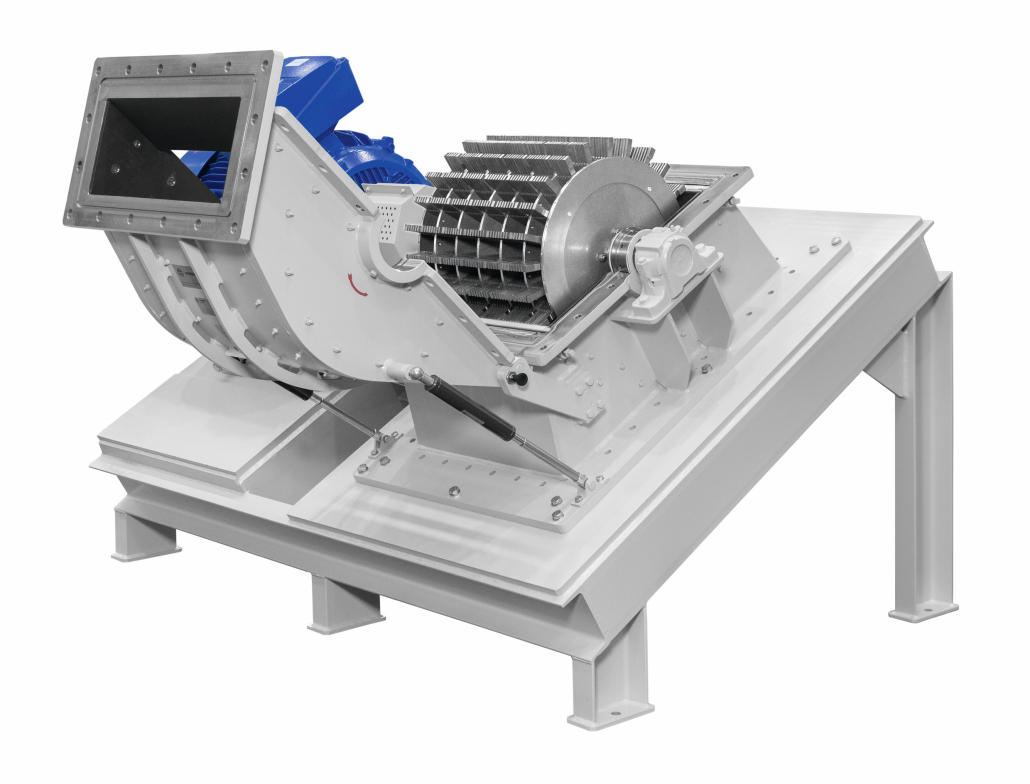
Hosokawa Alpine fits its Pulverizer with a rigid rotor for stubborn plant fibres
Hosokawa Alpine has expanded the range of applications for its Pulverizer hammer and screen mill with a new Rigid rotor, developed specifically for fibrous materials. The Augsburg, Germany-based company says the change creates new options for processing plant fibres in the food industry, including raw materials with a high fibre and moisture content, such as chillies.
Fibres as functional ingredients
According to the company, plant-based fibres derived from citrus peel, edible oil press cake, wheat bran or oats are becoming increasingly important as functional ingredients. It says they improve the texture, water-binding capacity and nutritional value of food while contributing to the resource-efficient use of by-products. To process these raw materials efficiently, the company adds, the right grinding process is crucial.
With the Rigid rotor, the Pulverizer can grind fibres uniformly and reproducibly to the desired particle size, which Hosokawa Alpine describes as an essential prerequisite for their functional properties in later applications. The company says the robust and efficient design achieves optimal particle sizes, improving the uniformity, palatability and digestibility of the end products.
Hammer mill feed, fine impact mill fineness
The Pulverizer can be configured to suit the raw material and the desired particle size. Rotor speed, grinding tools, air flow rate and screen size can be adjusted individually, enabling a wide range of finenesses. The company also highlights its compact design, high throughput rates and low-maintenance construction.
“The Pulverizer combines the best of both worlds: the hammer mill and the fine impact mill,” says Melanie Sigmund, Sales Manager Food at Hosokawa Alpine. “It has a large feed opening, like a hammer mill, so that even whole chili peppers can be fed in without prior pre-cutting. At the same time, the high rotational speeds enable particle sizes comparable to those achieved with a fine impact mill.”
By adjusting process parameters, users can achieve the particle sizes required for a specific application. The company says this ensures consistently high product quality, reduces waste and facilitates the integration of new, sustainable raw materials into existing production processes.
More value from plant-based sidestreams
Hosokawa Alpine says the Rigid rotor is aimed in particular at the processing of dietary fibre from plant-based raw materials, opening up new possibilities for the production of functional ingredients.
“Plant-based by-products such as wheat bran, pea hulls and husk meal, sunflower extraction meal or brewers’ grains hold enormous potential for the food industry. With our new fibre rotor, we enable customers to process these raw materials specifically into high-quality functional ingredients,” says Sigmund. “The combination of high process flexibility, reproducible results and cost-effective operation lays the foundation for greater value creation and the optimal
utilisation of existing resources.”
Process solutions from a single source
As part of the Hosokawa Micron Group, Hosokawa Alpine says it can offer more than the grinding technology itself. Together with the group’s sister companies, integrated solutions are developed and implemented for the entire process chain, including the dosing, weighing, conveying, drying and mixing of raw materials, as well as grinding and subsequent product storage. The company says this gives customers a fully coordinated overall concept from a single source, which reduces interfaces, simplifies project implementation and ensures a high level of process reliability across all production stages.
For more information, visit: www.hosokawa-alpine.com
Digital issue: Please click here for more information