


Container glass at the PPWR threshold: What European filling lines must plan for
Now that the European Packaging and Packaging Waste Regulation (EU) 2025/40 has entered into application, Bella Wang, Export Director at Optimizing Glass Bottle, examines what its graded recyclability thresholds mean for container glass. She analyses the data behind European collection rates, reports on lightweighting as a compliance lever, and outlines how European filling-line operators can structure sourcing to meet the 2030 and 2038 recyclability grades.
Abstract
The Packaging and Packaging Waste Regulation (PPWR), Regulation (EU) 2025/40, applies from August 2026 and rewrites the compliance baseline for every pack placed on the EU market. For food and drink producers, container glass sits in an unusually strong position: it is mono-material, endlessly recyclable, and already collected at around 80 per cent across the EU. Yet the regulation’s graded recyclability ladder for 2030 and 2038, its declaration and labelling duties, and its minimisation rules still carry concrete consequences for specification, sourcing and line planning. This article examines the data behind glass recycling in Europe, the practical meaning of the recyclability grades for glass containers, and how European fillers can structure supply relationships – including with non-EU manufacturers – to stay ahead of the curve.
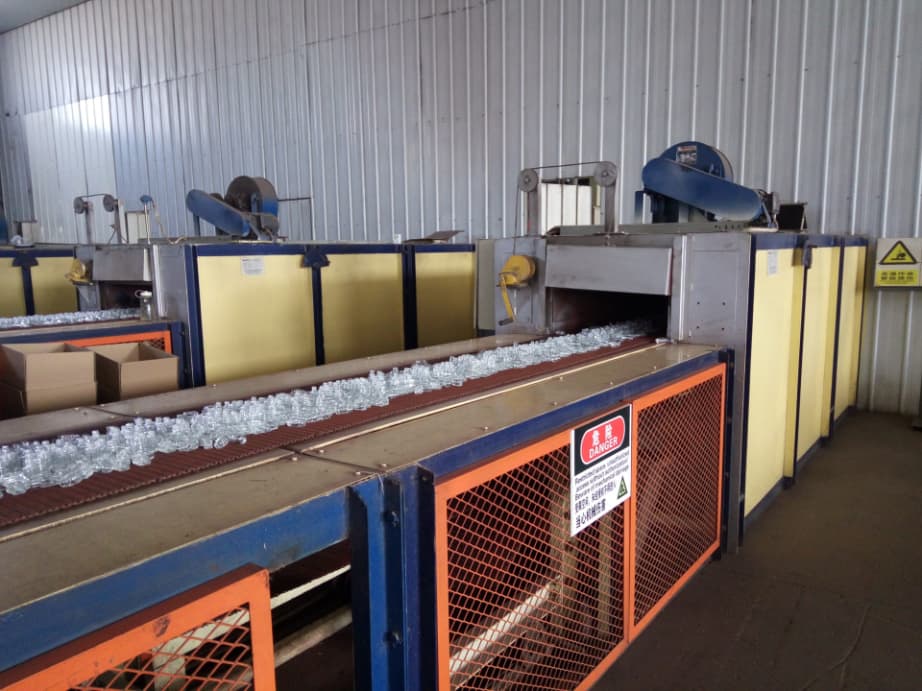
Container glass production: bottles leaving the annealing lehr – a specialized, long oven used to cool newly formed glass gradually and remove internal mechanical stresses
Background
European packaging policy has moved from directive to regulation. The PPWR entered into force in February 2025 and applies directly in all member states from 12 August 2026, replacing Directive 94/62/EC. Unlike its predecessor, it leaves no transposition gaps: design-for-recycling criteria, extended producer responsibility (EPR) duties, labelling and declarations of conformity will apply uniformly from Finland to Portugal.
Container glass enters this new era with strong fundamentals. According to FEVE, the European container glass federation, the average EU collection rate for glass packaging stands at roughly 80 per cent, with Germany among the leaders at about 85 per cent. Eurostat’s packaging waste statistics confirm glass as one of the best-performing packaging materials in the European recycling system. Under the PPWR’s material-specific recycling targets, member states must recycle 75 per cent of glass packaging waste by the end of 2030 – a threshold the best national systems already exceed.
For filling-line operators and packaging buyers, however, headline recycling rates are only half the story. The regulation’s recyclability performance grades, its minimisation and empty-space rules, and the documentation duties attached to every pack placed on the market all land on the desk of the person specifying the container – and, by extension, on their suppliers.
The 2030 and 2038 recyclability ladder
At the heart of the PPWR’s design requirements sits a graded definition of recyclability. From 1 January 2030, packaging may only be placed on the EU market if it achieves at least Grade C under the recyclability performance criteria; from 1 January 2038, the floor rises to Grade B. Anything below the floor falls off the market.
A standard glass bottle or jar is structurally well placed for this ladder. Glass is a mono-material that can be remelted indefinitely without quality loss, and the European collection and beneficiation infrastructure for container glass is mature. The grade risk for a glass container rarely sits in the glass itself – it sits in what is added to it. Closures with multi-material liners, full-body sleeves that interfere with colour sorting, ceramic inks that contaminate cullet streams, and non-removable pumps or dispensers can each pull an otherwise recyclable pack down the grading scale. For food and drink fillers, the consequence is that recyclability reviews should cover the complete pack system – container, closure, label and decoration – rather than the container alone.
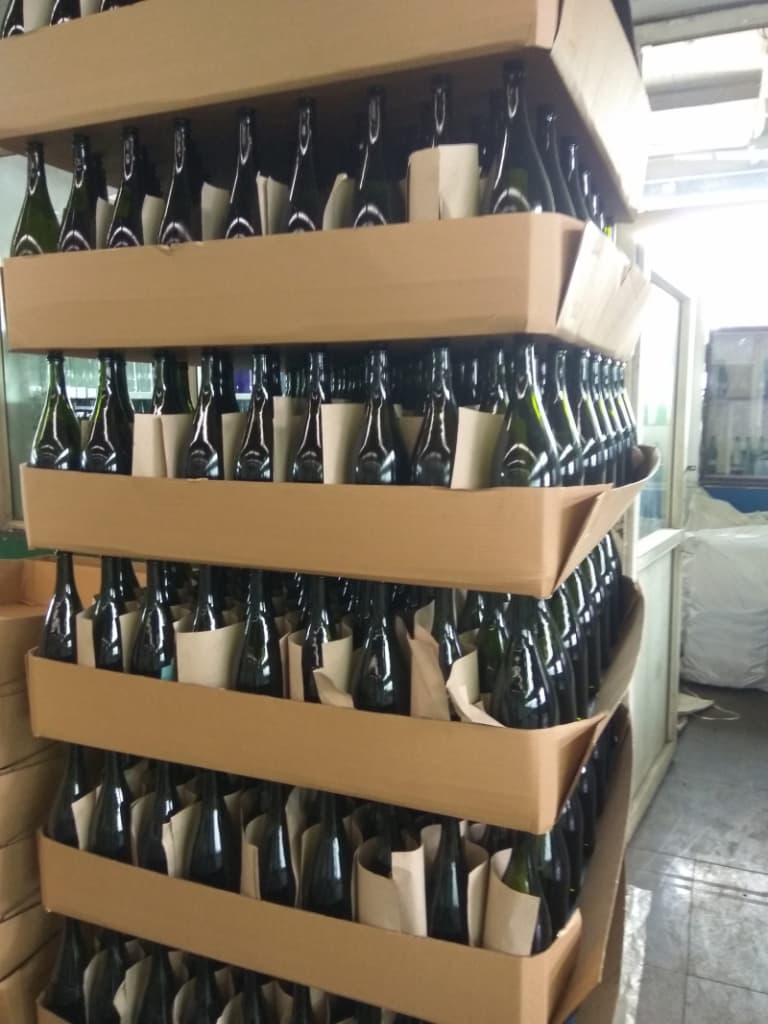
Beverage bottles packed in layer trays awaiting export shipment
What the recycling data says
The roughly 80 per cent EU average for container glass collection conceals a wide spread. Germany’s approximately 85 per cent reflects decades of colour-separated bottle banks and deposit-driven return culture; several southern and eastern member states sit well below the average. FEVE’s long-running “Close the Glass Loop” programme targets a 90 per cent collection rate by 2030, and the PPWR’s 75 per cent recycling target for glass by end-2030 gives that ambition regulatory backing.
For brand owners, two data points are operationally important. First, cullet quality: every ten per cent of recycled cullet in the furnace reduces melting energy by roughly two to three per cent, because cullet melts at a lower temperature than virgin batch. High-quality, colour-sorted cullet is therefore both a decarbonisation lever and a cost stabiliser for glassmakers – and its availability depends on the collection systems into which a pack is sold. Second, regional disclosure: under the PPWR’s labelling and declaration regime, the composition and disposal information carried by a pack must be defensible in every market where it is sold, which argues for conservative, source-documented recycling claims rather than best-case national figures.
Lightweighting as the compliance lever
The PPWR’s minimisation principle requires packaging weight and volume to be reduced to the minimum necessary for function. For glass containers, this legitimises – indeed accelerates – a trend the industry has pursued for years: lightweighting.
Modern narrow-neck press-and-blow and advanced blow-and-blow processes allow beverage bottles to be produced at weights that would have been considered fragile a decade ago, while maintaining top-load strength and impact resistance for high-speed filling. The figures are compelling. Removing 30 to 60 grams from a 330 ml or 500 ml beverage bottle cuts raw material per unit, reduces furnace energy per tonne of saleable glass, and lowers transport emissions across every leg of the supply chain – container logistics to the filler, filled-goods distribution, and reverse flows where they exist. On a pan-European distribution footprint, a 15 per cent container weight reduction typically translates into a double-digit percentage saving in glass-related transport CO2.
Lightweighting does, however, shift responsibility onto process control. Wall-thickness distribution, annealing quality and surface treatment become critical at reduced weights, and fillers are entitled to ask suppliers for the supporting data: wall-thickness mapping, thermal shock performance, and line-trial results at target speeds.
A practical example illustrates the scale of the opportunity. A European soft-drinks brand filling 40 million 500 ml bottles a year and moving from a 350-gram to a 300-gram container removes 2,000 tonnes of glass from its annual material flow before a single other parameter is touched. At typical container-glass melting energy, that is a four-figure megawatt-hour saving at the furnace, several hundred tonnes of avoided CO2 across production and transport, and a measurable reduction in packaging tax or EPR fees in member states that modulate by weight. None of this requires new technology – only disciplined specification and a supplier able to hold tight process windows at the lower weight.
Sourcing under the PPWR: working with non-EU manufacturers
Nothing in the regulation requires packaging to be manufactured in Europe. It does, however, make the economic operator who places a packaged product on the EU market responsible for documentation – the declaration of conformity covering recyclability grade, composition and regulatory compliance. For fillers sourcing glass containers from outside the EU, this means the supplier relationship must deliver evidence, not just product.
In practice, a workable model has three elements. First, technical transparency: full material disclosure, production batch records and test data that allow the importer’s declaration of conformity to be completed without guesswork. Second, design collaboration: private-mould development, once reserved for very large volumes, is now accessible from runs of around 1,000 pieces, allowing brand owners to specify weight, finish and decoration with the 2038 grade ladder in mind rather than retrofitting compliance later. Third, logistics realism: FOB Shanghai terms with consolidated container shipping give European buyers predictable landed costs, while stock programmes for standard finishes cover short-lead requirements.
Technical considerations
Specifying lightweight glass containers for European filling lines requires attention to a short list of parameters. Wall thickness should be verified by section measurement across the body, shoulder and heel, with minimum values agreed per weight class; typical lightweight beverage bottles operate at wall thicknesses roughly 20 to 30 per cent below their standard-weight predecessors. Annealing must relieve residual stress to levels compatible with pasteurisation and hot-fill processes where applicable. Hot-end and cold-end surface coatings preserve scuff resistance and lubricity, which directly affects line efficiency at speeds above 40,000 containers per hour. Neck finish tolerances to CETIE or equivalent standards ensure closure compatibility without change parts. Batch-to-batch consistency should be demonstrated through statistical process control charts covering weight, capacity and brim-full volume, since lightweight designs tolerate less variation before downstream effects appear at the filler or capper. Incoming quality control should run to agreed AQL levels with defined sampling per batch – the documentation of which feeds directly into the buyer’s conformity file. Where recycled-content or carbon claims are made in marketing, the supporting cullet ratios and energy data should be traceable to furnace records rather than estimates.
Conclusions
The PPWR rewards exactly what well-made container glass already offers: mono-material simplicity, proven collection systems and genuine closed-loop recycling. The 2030 and 2038 recyclability grades will nonetheless force a pack-system-level review of closures, decoration and labels, and the documentation duties will reward suppliers who provide evidence rather than assurances. Fillers that treat the regulation as a specification exercise – lighter containers, verified performance data, documented sourcing – will find compliance largely a by-product of good procurement. The final message is simple: in glass, sustainability and supply-chain discipline are now the same conversation.
About the author
Bella Wang is Export Director at Optimizing Glass Bottle, a Shanghai-based manufacturer of glass bottles and jars for food, beverage and cosmetics applications. She works with European brand owners and fillers on private-mould projects, lightweighting programmes and packaging compliance for the EU market.
- Visit: https://www.optimizingglassbottle.com
or email: bella@optimizingpack.com
References
- European Union. Regulation (EU) 2025/40 of the European Parliament and of the Council on packaging and packaging waste. Official Journal of the European Union; 2025.
- Eurostat. Packaging waste statistics – recycling rates by material. Luxembourg: European Commission; 2024.
- FEVE – The European Container Glass Federation. Glass packaging recycling in Europe: collection rates and the Close the Glass Loop programme. Brussels: FEVE; 2024.
- Glass Packaging Institute. Glass container recycling and cullet use in container manufacturing. Alexandria, VA: GPI; 2023.
- Optimizing Glass Bottle. Glass packaging sustainability data hub [Internet]. Shanghai; 2026. Available from: https://www.optimizingglassbottle.com/glass-packaging-sustainability-data