Macroalgae hydrocolloids: How seaweed-derived carrageenan, agar, alginate, ulvan and fucoidan are reshaping food formulation and functional nutrition
Macroalgae-derived hydrocolloids are emerging as dual-purpose ingredients for the food industry, combining gelling, thickening and stabilising performance with documented antioxidant, anti-inflammatory and metabolism-modulating activity. A new review in European Food Research and Technology consolidates the chemistry, extraction strategies and health effects of carrageenan, agar, alginate, ulvan and fucoidan in a single integrated framework.

Agar seaweed, South Sulawesi, Indonesia CC: Fabio Achilli/Flickr
A team led by Tuba Esatbeyoglu at Leibniz University Hannover, working with collaborators across Germany, Turkey, Australia, Indonesia and India, has published a wide-ranging synthesis arguing that seaweed polysaccharides should no longer be evaluated through either a purely technological or a purely nutritional lens. The authors make the case that these two perspectives are inseparable in practice – and that the food industry stands to benefit from treating them as such.
Why this matters for food manufacturers now
The implications for food formulators are immediate. As the authors put it, macroalgal hydrocolloids “exhibit not only outstanding techno-functional capabilities such as gel formation, thickening, stabilization, and viscosity modification, but also important biological activities such as antioxidant, anti-inflammatory, antimicrobial, and anticancer effects.” For product developers chasing clean-label, plant-based and functional positioning at the same time, that combination is commercially significant.
Three industry-relevant takeaways stand out from the review:
First, sourcing and supply scale are no longer barriers. Global macroalgae production climbed from 34.7 thousand tons in 1950 to 34.7 million tons in 2019, with 97% coming from aquaculture. Roughly 300 species are commercially exploited across about 50 countries.
Second, the structure-function relationship is now well-defined enough to guide ingredient selection. The M/G ratio in alginate governs gel stiffness and ion-binding affinity. The sulfation pattern in carrageenan dictates whether κ-, ι- or λ-fractions deliver firm gels, elastic gels or pure thickening. Fucoidan’s bioactivity tracks directly to sulphate content and molecular weight. Formulators can specify performance with increasing precision.
Third, regulatory status across the major hydrocolloids is largely settled for adult populations – although the review flags that EFSA still considers data insufficient to confirm safety of alginic acid and its salts (E400–E404) in infant formulas and foods for special medical purposes.
The clean-label and packaging angle
Macroalgal polysaccharides are showing up in two distinct food-industry workstreams: ingredient functionality inside the formulation, and biodegradable packaging around it.
On the formulation side, the review catalogues a long list of validated applications. Carrageenan is acting as a textural modifier in plant-based meat, reduced-fat chicken patties, surimi gels and high-protein ice cream. Alginate is supporting encapsulation of omega-3 oils, probiotics and polyphenols, and serving as an edible coating that extended chicken shelf life, cherry tomato firmness and dried apricot vitamin C retention. Agar is delivering vegan gummy candies, fat replacement in Frankfurter sausages (cutting total fat from 25.37 to 17.07 g/g and caloric content by 25%) and oleogel structuring in shortbread cookies. Ulvan and fucoidan, though newer to commercial food matrices, are showing promise in functional yoghurt, mango coatings and bread with reduced glycaemic index.
On the packaging side, the authors describe agar-based films reinforced with nano-bacterial cellulose, sodium alginate films that extended strawberry shelf life through antioxidant and antimicrobial activity, and κ-carrageenan films infused with mulberry polyphenol extract for pH-sensitive freshness monitoring of milk. Ulvan-carnauba wax blends and fucoidan-alginate composite films round out the active and intelligent packaging examples.
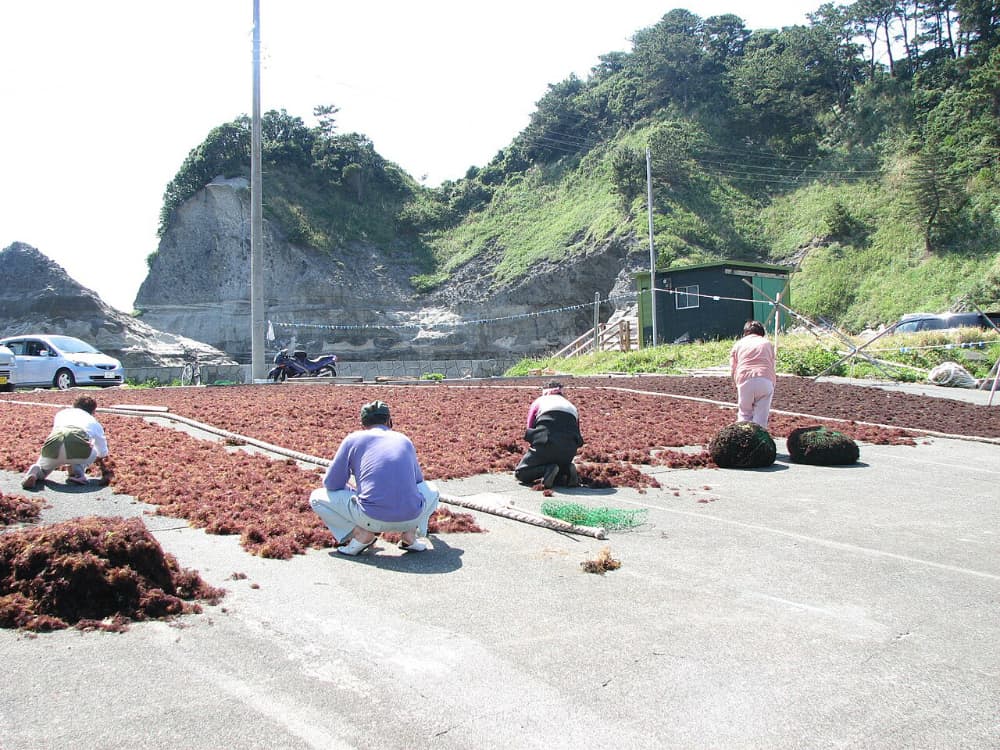
Tengusa (Agar seaweed) drying at Izu, Japan. CC – https://commons.wikimedia.org/wiki/File:Tengusa_work.jpg
Extraction technology is the bottleneck – and the opportunity
For ingredient suppliers, extraction methodology is where competitive advantage now sits. The review compares conventional hot-water and alkaline extraction against newer approaches including microwave-assisted extraction (MAE), ultrasound-assisted extraction (UAE), enzyme-assisted extraction (EAE), pressurised liquid extraction (PLE), supercritical fluid extraction and hybrid methods.
The yield improvements are substantial. Ultrasound-assisted extraction lifted alginate recovery from Sargassum binderi and Turbinaria ornata to roughly 54% at pH 12 in 40 minutes, compared with 27% for two-hour conventional extraction. MAE pushed fucoidan extraction efficiency to 30-70% with short treatment times. For ulvan, hybrid ultrasonic-enzymatic treatment achieved 26.7% yield while also delivering noticeably better DPPH (2,2-diphenyl-1-picrylhydrazyl) radical scavenging than hot water extraction alone.
The catch: most green methods remain stuck at pilot stage. The authors are direct about this – high equipment costs, limited knowledge for process optimisation and difficulties scaling to industrial throughput keep conventional extraction dominant. That said, the alignment of advanced extraction with circular-economy frameworks gives the technologies a strong tailwind.
Structure dictates the health story
One of the review’s more practical contributions to the functional food conversation is its mapping of each hydrocolloid to a specific molecular pathway. As the authors write, these compounds “act through distinct, structure-dependent mechanisms; they do not share a single pathway of action.”
Fucoidan attenuates inflammatory signalling via NF-κB, with PI3K/AKT/Nrf2 signalling and AMPK crosstalk in metabolic tissues. Alginate works largely through gastrointestinal viscosity, delayed gastric emptying and incretin responses (GLP-1, PYY) that reduce energy intake. Carrageenan shows dose- and type-dependent immunomodulation in macrophages and epithelial models, with host-context sensitivity. Ulvan is fermented to short-chain fatty acids that signal via GPR41/43 and HDAC inhibition to reinforce barrier integrity.
This matters commercially because it means each hydrocolloid carries a distinct functional food positioning. Alginate sits naturally in satiety and weight-management products. Fucoidan fits anti-inflammatory and metabolic-health applications, with FDA GRAS status up to 250 mg/day. Ulvan is a gut-health story. The structural specificity also explains why carrageenan health claims need careful framing – food-grade E407 is considered safe for general consumption, but low-molecular-weight fractions (poligeenan, below 50 kDa) are restricted, and the authors note that “epithelial cells from Crohn’s disease patients exhibited heightened inflammatory profiles, highlighting host-context sensitivity.”
Sustainability credentials and the obstacles ahead
The authors frame macroalgae as an answer to the projected food security pressures of a 9.8 billion global population by 2050, noting their suitability for low-impact production strategies, no requirement for arable land and low resource demands. They observe that “great structural diversity of algal polysaccharides, including carrageenan, agar, alginate, ulvan, and fucoidan, supports a variety of biological and functional characteristics.”
But the review does not shy away from what is missing. Poor oral bioavailability – driven by high molecular weight, extensive sulfation and limited intestinal permeability – restricts systemic absorption. Long-term human clinical trials remain scarce. Structural heterogeneity arising from species, season and extraction protocol complicates standardisation and regulatory approval. And while nanoparticle encapsulation, enzymatic modification and probiotic co-administration are all being explored to improve absorption, “most remain at the preclinical stage.”
In the conclusion, the authors argue that “macroalgae are seen as an effective alternative to traditional food sources due to their lack of need for arable land, low resource requirements and environmentally friendly production characteristics,” while flagging that “standardized extraction and purification procedures are urgently needed to guarantee reproducibility and comparability across investigations to fully realize their application.”
For food scientists, the message is straightforward: the techno-functional case for macroalgal hydrocolloids is largely made. The health case is structure-specific and increasingly mechanistic. What remains is process standardisation, clinical validation in humans and the commercial scale-up of greener extraction routes.
Reference
Kezer, G., Yusufoğlu, B., Namlı, S., et al. (2026). Macroalgae-derived hydrocolloids and their applications in food industry and their health effects. European Food Research and Technology, 252(172). https://doi.org/10.1007/s00217-026-05084-x