


Meatless study finds UK flexitarians favour hybrid meat over full-meat formats
A new consumer survey from Meatless, a brand of BENEO, indicates that hybrid meat products combining animal protein with plant-based ingredients are gaining ground among UK shoppers. The research points to authentic meat taste, premium quality signals and high-protein positioning as the decisive purchase drivers, with sausages emerging as the format most likely to convert flexitarian consumers in the category.

Niels E. Hower, Managing Director at Meatless. ©BENEO
The study, conducted across the United Kingdom, Germany and the Netherlands with 3,500 respondents, was designed to inform formulation and marketing strategies for hybrid meat applications, in which plant-based texturates replace a portion of the meat content. In the UK sample, four in ten respondents self-identified as flexitarian, a cohort the report positions as the primary commercial target for hybrid formats.
According to the findings, six in ten UK consumers said they would be willing to purchase hybrid meat products provided the taste is good and the price point is acceptable. Notably, purchase intent was found to be driven more strongly by positive attributes of the meat component than by the plant-based fraction, with “real meat taste” identified as a fundamental requirement for category acceptance.
Meat quality cues outweigh plant-based credentials
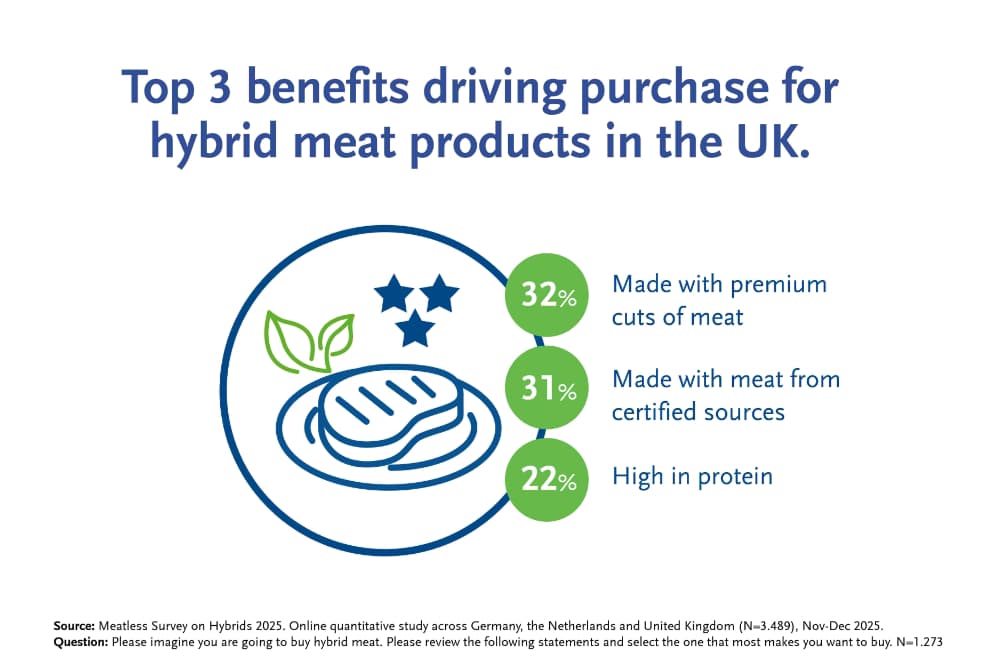
The survey indicates that premium meat quality signals, including premium cuts, certified meat, authentic taste and texture, contribute substantially to purchase intent among UK consumers. This represents a meaningful insight for product developers, suggesting that hybrid formulations should be engineered and communicated as meat-led propositions rather than as plant-forward alternatives.
For food scientists working on reformulation, the implication is that sensory parity with conventional meat products, particularly with respect to juiciness, bite and mouthfeel, remains the critical technical hurdle. Meatless reports that its texturates, produced from raw materials including faba bean, rice and mycoproteins, are formulated to deliver a familiar meaty character while improving juiciness and the overall nutritional profile of the finished product.
Protein content is the leading driver for younger consumers
Nutritional positioning emerged as a stronger purchase driver in the UK than in either Germany or the Netherlands. The “high in protein” claim ranked among the top three statements influencing purchase intent for UK respondents overall, and was identified as the single most influential factor among Millennials and Gen Z consumers.
For technical teams, this places protein quantification and quality high on the formulation agenda. Hybrid systems that combine animal protein with complementary plant proteins, such as faba bean and mycoprotein, offer a route to maintaining or elevating total protein content while reducing saturated fat and carbon footprint relative to a full-meat reference.
Sausages lead format preferences
When asked about format, almost half of UK respondents selected sausages as their preferred hybrid application, followed by minced meat at 33% and hamburger patties at 15%. When given a direct choice between full-meat and hybrid versions, flexitarian consumers showed a clear preference for the hybrid option across all three formats.
The sausage finding is technically significant: emulsion-style products typically tolerate partial meat replacement with greater sensory robustness than whole-muscle analogues, making them a logical entry point for manufacturers piloting hybrid lines.
Industry perspective
Niels E. Hower, Managing Director at Meatless, said: “As one of the first suppliers to focus on hybrid solutions, Meatless has long believed in the power of combining meat and plants. Our survey confirms that this pragmatic approach of reducing meat by maintaining great taste is key. We are supporting our customers in creating products that fit seamlessly into everyday eating habits and are confident that hybrid will establish itself as a concept that is here to stay, helping to overcome sustainability and availability challenges of the meat category.”
Tools for reformulation
To assist manufacturers in quantifying the commercial and environmental case for hybrid reformulation, Meatless has developed a cost calculator that compares conventional recipes with hybrid formulations on cost, CO₂ equivalents, saturated fat and energy content. The tool is intended to support technical and procurement teams in building a business case for partial meat replacement, particularly against a backdrop of rising raw material costs in the meat category.
Meatless operates from a production site in Goes, the Netherlands, where it processes faba beans, mycoprotein, rice and quinoa into texturising solutions and semi-finished products for plant-based and hybrid meat and fish applications. BENEO, formed in 2007, is active in over 80 countries and operates seven production sites across Belgium, Chile, Germany, Italy and the Netherlands.
- For more information, visit: https://www.beneo.com/meatless-hybrid