

Researchers develop smart packaging film that flags meat spoilage by colour shift and UV fluorescence
Researchers at Kyushu University have developed a casein-based packaging film that changes colour and glows under ultraviolet light as refrigerated mutton spoils, while also slowing spoilage markers. Tested over 16 days at 4 °C, the dual-mode film gives food scientists a freshness indicator that works under both ambient and low-light conditions, with substantial disintegration under soil and seawater tests.
Sensing and preservation in a single film
Researchers at Kyushu University and partner institutions have developed a milk-protein packaging film that reports on the freshness of refrigerated mutton in two ways: through gradual colour change under ambient light, and through fluorescence that switches on under ultraviolet (UV) light. The work appeared in Chemical Engineering Journal, where it was first available online on 29 August 2026.
For food manufacturers and packaging technologists, the paper points to three practical features. The two optical signals cover different conditions. The authors wrote: “The colorimetric mode enables convenient routine observation, whereas the high-contrast fluorescence mode facilitates detection in low-light or dark environments and can provide rapid confirmatory screening using a portable UV source.” The best formulation, labelled CAS/mBSSC/Z2, also slowed spoilage markers in the pack relative to a lower-loading version. And the casein-based films showed substantial disintegration and mass loss under the soil-burial and seawater conditions tested. The press release adds that such films could give consumers, retailers and distributors an additional visual indication of freshness alongside conventional date labelling.
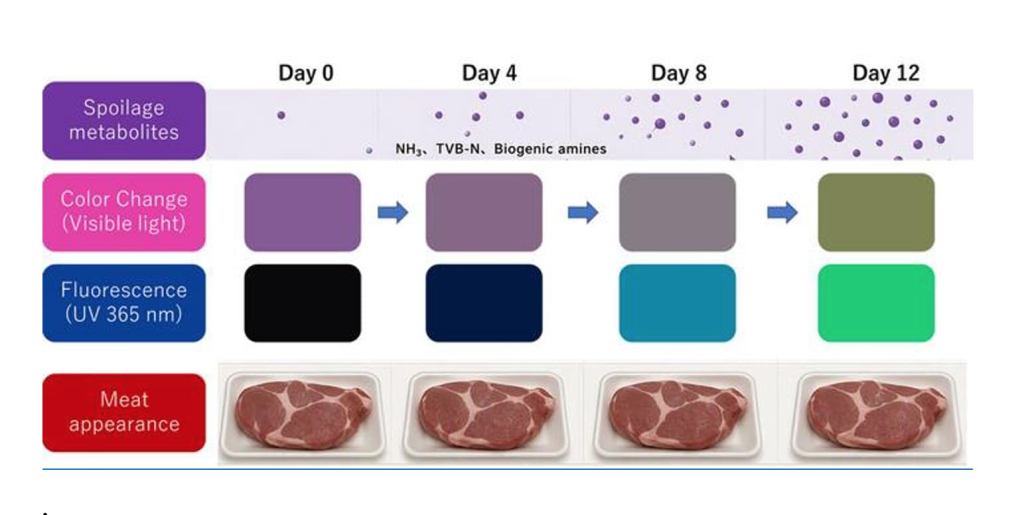
The developed packaging film detects ammonia and other volatile basic compounds produced during meat spoilage. The film responds through both visible colour changes and fluorescence activation under UV light, allowing convenient freshness monitoring under different environmental conditions. The technology combines sensing, preservation, and sustainability functions within a single biodegradable packaging platform.
© Fumihiko Tanaka/ Kyushu University
Why colour alone falls short
Packaging typically protects food but, the press release notes, provides little information about its quality. Anthocyanins, natural plant pigments that change colour with acidity, can indicate freshness, yet their colour changes can be subtle in the early stages and affected by lighting conditions.
The paper sets out why mutton is a demanding test case. During storage, endogenous enzymatic reactions and microbial growth accelerate nutrient degradation and the build-up of spoilage metabolites. In refrigerated mutton, pH varies within a relatively narrow, mildly acidic to neutral range of approximately 5–7, which the authors say limits the early-stage readability of purely colorimetric indicators. Existing intelligent films, they add, still depend largely on a single-colour signal.
“We wanted to combine colour changes with fluorescence to make signs of spoilage easier to recognize,” says Xirui Yan, a JSPS researcher at Kyushu University and the paper’s first author. “Colour provides a simple visual indication, while fluorescence under UV light offers a clearer signal when colour differences are difficult to see.”
How the film was built and tested
The team, led by Professor Fumihiko Tanaka and Associate Professor Fumina Tanaka of Kyushu University’s Faculty of Agriculture, worked with collaborators from Nanjing Agricultural University, Ghent University and Nguyen Tat Thanh University. Casein forms the film matrix. The colour-responsive component is a black soybean seed coat anthocyanin extract, an abundant, low-cost agro-industrial by-product. It was reacted with pyridine in acetate buffer (pH 4.5) at 25 °C for 8 hours to give a fluorescence-active product (mBSSC).
Spectroscopy showed the main visible absorption band shifting from approximately 521 nm to 492 nm, with an emission maximum near 537 nm; the native extract fluoresced only weakly. The modified pigment’s fluorescence was weak at pH 2–7, pronounced above pH 8 and highest at pH 12.
The pigment was hybridised with zeolitic imidazolate framework-67 (ZIF-67), a porous metal–organic framework, and cast into casein films at ZIF-67 loadings of 10%, 20% and 30% of the pigment mass, designated Z1, Z2 and Z3. For the freshness trial, 10.0 g mutton samples were sealed in Petri dishes with a 2 × 2 cm film on the inner lid, at least 3 mm from the meat surface, and stored at 4 °C for 16 days. Independent packages were opened every two days for destructive analysis, and fluorescence was imaged under a 365 nm lamp in the dark every 48 hours.
Results: earlier signals and slower spoilage
Fluorescence turn-on depended on ZIF-67 content. The film without ZIF-67 (CAS/mBSSC) began to glow at around day 10, Z1 at day 8, and Z2 and Z3 at around day 6. The blank control and neat casein stayed dark throughout. Under ordinary light, Z2 and Z3 moved from pale pink or light purplish hues at days 0–4, through greyish tones at days 6–10, to greenish-cyan by days 12–14. In ammonia-vapour tests, Z2 and Z3 showed visible colour change within 0.5–1 minute at 100 and 200 ppm.
Mutton quality data favoured the higher-loading films. Total volatile basic nitrogen (TVB-N) crossed the 15 mg/100 g freshness limit at approximately day 8 with Z1 and closer to day 10 with Z2 and Z3, which the authors describe as an approximately two-day extension of acceptable freshness. By day 16, TVB-N reached 24–25 mg/100 g with Z1 against 22–23 mg/100 g with Z2 and Z3. Weight loss was about 8.8% with Z1 and about 8.1% with Z2 and Z3. Total viable counts at day 16 were 12.6 log CFU/g with Z1 and 8.8 log CFU/g with Z2.
The film properties improved as well. Water vapour permeability fell from 12.4 × 10⁻¹¹ to 6.2 × 10⁻¹¹ g·m⁻¹·s⁻¹·m²·Pa⁻¹ at the highest loading (Z3). Water contact angle rose from 52.4° for neat casein to 78.6° for Z2, while moisture content fell from 23.2% to 15.3%. Antioxidant (DPPH) activity at day 0 was 56.81% for Z2, which retained 86.4% of it after 28 days. Inhibition zones for Z2 reached 37.57 mm against S. aureus and 19.50 mm against E. coli, and the films tolerated folding, rolling and a 300 g load.
Interpretation, safety and limitations
The authors identified Z2 as the best compromise. “CAS/mBSSC/Z2 was identified as the most suitable formulation because it provided clear improvements in barrier properties, antioxidant activity, antibacterial performance, and freshness indication, while only limited additional benefits were obtained when the ZIF-67 content was further increased to Z3,” they wrote. At the highest loading, the paper reports visible agglomeration and faster loss of antioxidant activity.
Because ZIF-67 contains cobalt, the team measured it. Total cobalt in mutton ranged from 8.13 to 8.33 µg/kg with no loading-dependent trend. Lid rinsates from Z1–Z3 gave estimated levels of 0.11, 0.14 and 0.21 ng per dish, all below the 0.30 ng/dish limit of quantification; the authors suggest “trace Co-associated material was largely retained on the lid without producing measurable Co enrichment in the mutton”. Live/dead staining of L929 fibroblasts showed no evident cytotoxicity.
After 20 days of soil burial, endpoint mass loss was about 83% for neat casein and 78%, 80%, 89% and 92% for CAS/mBSSC and Z1–Z3. After 8 days in seawater it was about 95%, 77%, 87%, 88% and 90%. Cobalt release rose with loading, reaching approximately 28–75 µg/g of film in soil and 82–250 µg/g in seawater. The seawater was heat-sterilised, so the authors attribute the results mainly to physicochemical dissolution rather than microbial activity, and state that “these endpoints do not demonstrate complete mineralization or establish long-term environmental safety”. Other limits: naked-eye discrimination of some adjacent storage stages remained limited, and performance was assessed under controlled laboratory conditions. Condensation, prolonged humidity and the mechanical and oxygen-barrier demands of chilled packaging still need to be validated.
Next steps for smart packaging
The researchers propose extending the film to other perishable foods, testing the fluorescence mode under realistic supply-chain conditions, pairing a portable UV source with smartphone-based image analysis for quantitative readout, and refining the formulation for safety, sensitivity and practical applicability.
“As food packaging evolves from passive protection to intelligent sensing, our film provides smart sensing that could ultimately support smartphone-based and artificial intelligence-assisted freshness monitoring,” concludes Fumihiko Tanaka. By making quality changes easier to recognise, the team hopes to enhance food safety and reduce unnecessary food waste.
Reference
Yan, X., Meng, F., Zeng, J., et al. (2026). A casein-based dual-mode smart film enabled by pyridine-modified anthocyanins and ZIF-67 for real-time mutton freshness monitoring. Chemical Engineering Journal, 547, 181346. https://doi.org/10.1016/j.cej.2026.181346