

Shelved projects and unsolved problems: the untapped value inside food R&D
Giacomo Cattaneo, CEO and co-founder of FOOD FOUNDERS Studio, built and scaled EverGrain inside AB InBev. He examines why manufacturers archive R&D that works while living with problems nobody outside has been asked to solve, and argues that both are best taken forward by independent, co-founded ventures.

Giacomo Cattaneo
Introduction
The food industry holds two kinds of technical value it rarely puts on the table.
The first is the shelved project. When a manufacturer stops an R&D project, the science is often not the reason: the strategy changed, the budget cycle turned, the sponsor moved on. Prototypes, pilot data and know-how go into an archive, and lose value every time someone who built them leaves.
The second is the unsolved problem: not the kind a new supplier can fix, but the fundamental ones, including compromises the industry has learned to accept and no longer questions, such as an off-taste that limits a plant protein. The researchers who could solve them rarely hear about them in a form they can act on.
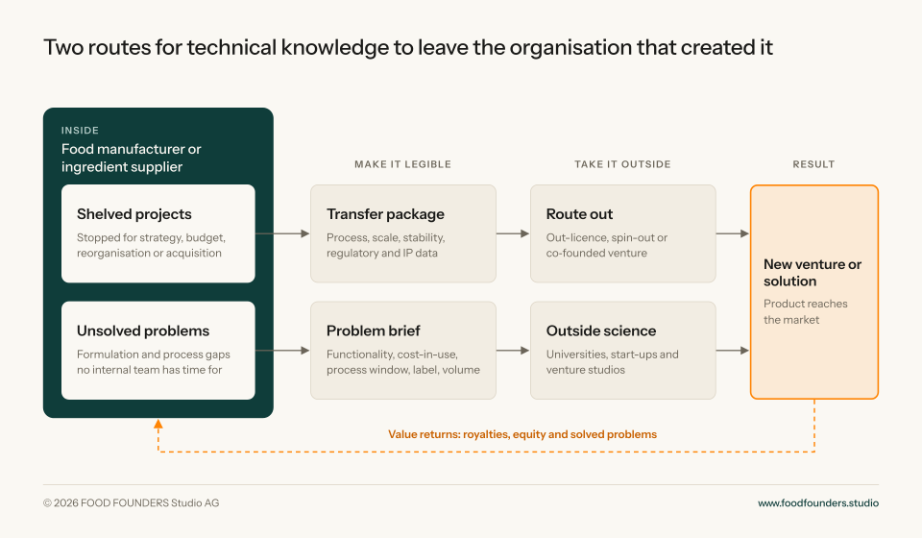
Both assets stay inside the organisation that holds them, and they leave by different doors: a shelved project needs a transfer package, an unsolved problem needs a brief (Figure 1). Both, this article argues, lead to the same answer: an independent venture, co-founded with experienced operators and a studio.
Background
The food and drink industry is the EU’s largest manufacturing sector, with a turnover of €1,196 billion in 2021, yet private R&D investment averaged only 0.24% of output from 2019 to 2021 [1]. On a base that narrow, every stopped project and every unsolved problem carries a visible cost.
Since Sarkar and Costa described a sector opening up to outside knowledge [2], most open innovation in food has run inward: companies scout start-ups and license university technology. The outward route gets far less attention, although patent data show how much stays inside. The PatVal-EU survey of 9,017 European patents found about 36% used neither internally nor through licensing; large firms left about 40% unused, against 18% for small firms [3]. In food, much know-how is never patented, so the unused share is unlikely to be smaller. EU policy now encourages putting such results to use [4, 5], but three gaps remain: no standard for what makes a project transferable, no routine channel for an unsolved problem, and no clear answer to who pays.
Part 1. Shelved, not failed: getting R&D out of the archive
Three routes out
Out-licensing suits a project with a clear use in a market the owner does not serve; the owner earns royalties but depends on a licensee to finish the job. A spin-out puts the project into a new company, with the parent contributing IP and people for equity; it suits projects close to the core business. A co-founded venture matches the technology with experienced founders from industry who commit full-time, and with outside capital; it suits projects that need a different business model or market from the parent’s.
Evidence from outside food favours the last route. Of 35 projects that left Xerox after internal funding ended, most achieved little, but the 11 that grew under different business models reached a combined market value about twice that of Xerox [6]. Spin-offs with more outside investors on their boards did better; those run by a Xerox insider did worse [7].
What makes a project transferable
A shelved project is transferable when an outside team can reproduce its key result without the original inventors. That takes a transfer package: formulation and process parameters with tolerances; the largest scale reached; analytical, shelf-life and safety data compatible with ISO 22000 [11]; regulatory status, including novel food status [12]; chain of title and freedom to operate; and retained samples, plus access to an original team member. Packaging a project when it is shelved, while the team is still there, costs a fraction of reconstructing it later.
Confidentiality, competition and control
Disclosure can be staged: a non-confidential summary, then data under a non-disclosure agreement, then a full data room once terms are agreed. Field-of-use licensing keeps the venture out of the owner’s core business. A right of first refusal and a minority stake let the parent share the upside; given the Xerox findings, control belongs in contracts, not in who runs the company [7].
The biggest barrier is internal: the team that shelved a project gains nothing from releasing it. A fixed review, for example 12 months after a project stops, at which each project is revived, offered out or closed, makes release a routine instead of a favour.
Case: why independence matters
Before co-founding the studio, Giacomo Cattaneo built and scaled EverGrain inside AB InBev. EverGrain turns barley left over from brewing into protein and fibre ingredients. Wholly owned and funded by AB InBev and its venture arm, ZX Ventures, it ran as a separate company with its own team and plant: a US$100 million conversion of a former brewery building in St Louis, opened in 2022. Its protein reached products from Post and Nestlé’s Garden of Life [8].
The science worked. The business did not, as a stand-alone, yet dependent venture. It followed the parent’s budget cycles and restructurings rather than its own market, and competed for capital with greenfield breweries expected to pay back in two to three years. In food ingredients, building demand takes longer than building supply, so the pressure to show scale fast created the wrong incentives. When growth fell short of the expectations that kept internal support alive, the project closed.
The lesson applies to both halves of this article: a venture that depends on a single parent follows that parent’s priorities, not its markets.
Part 2. Unsolved problems: from one company’s brief to an industry problem map
Why single-company briefs rarely travel
People don’t eat technology, they eat food. A problem a manufacturer would pay to fix is therefore a better starting point for a venture than a technology looking for a use. But most briefs never reach anyone who could solve them. Portal challenges are often too vague to act on, and confidentiality strips out the constraints that decide the answer: cost-in-use, process fit, labelling, and the validation a corporate partner needs before committing. A single-company brief also represents one buyer, often one that asks for exclusivity. Investors read that as dependence, and the EverGrain lesson applies again.
The industry problem map
The alternative is to build the brief from many conversations. FOOD FOUNDERS Studio runs structured problem interviews with R&D and open innovation leaders across the value chain, probing for accepted compromises as well as open problems. Problems that recur are mapped, quantified, weighted by who raised them, and matched with technologies from universities and start-ups. A problem confirmed this way:
- Is a market signal, not a client request: demand is tested before any technology is chosen;
- Can be precise without being confidential: constraints are triangulated across interviews and stated as ranges, with no company-specific prices, volumes or plans;
- Tells researchers what to work on: problems without a matching technology stay visible;
- Keeps the problem owners’ options open: sharing costs nothing, and exclusivity on a specific solution remains possible as a paid, later commercial step.
What a useful brief states
Whether it comes from one company or a map, a brief should put limits in numbers, so a researcher can judge within an hour whether a technology could meet them (Table 1).
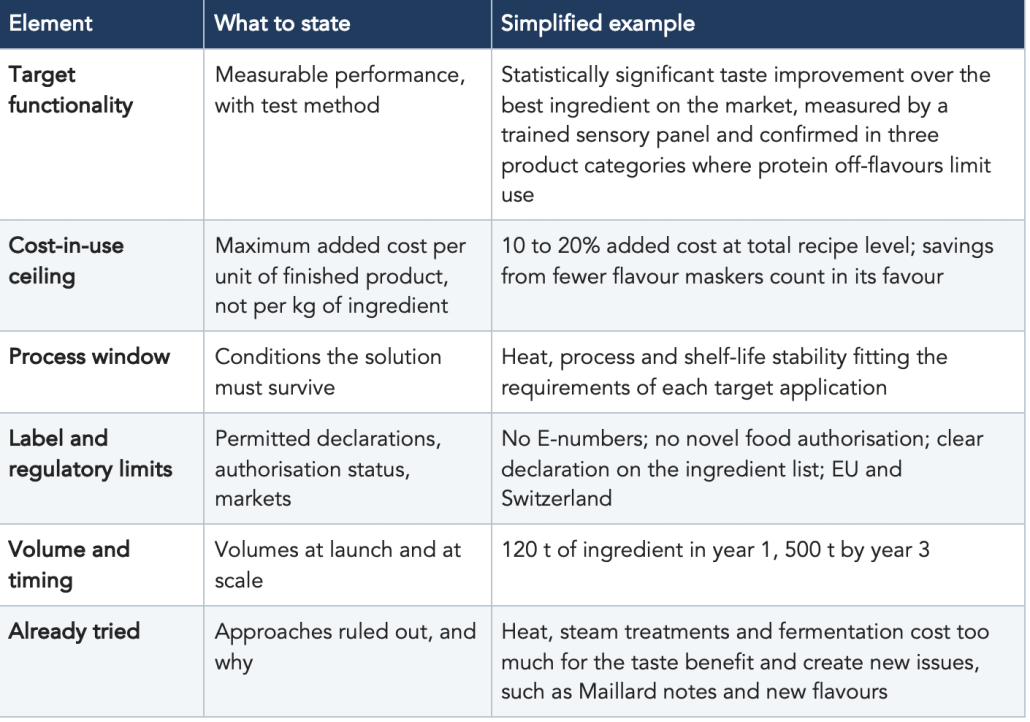
Table 1. Elements of a problem brief, with illustrative values for a neutral-tasting legume protein ingredient, as aggregated across several manufacturers, simplified for illustration.
A real brief states these values per application: the process windows for a UHT drink and an extruded snack differ widely. Two more things draw serious answers: a named technical contact who replies within a week, and a stated next step, such as a paid feasibility study, a joint development agreement, or a licence to co-found a venture with a studio.
From problem to company
Over the past year, FOOD FOUNDERS Studio assessed more than 100 food and beverage technologies. Nine passed industry validation. The studio committed its full resources to one, preferring to back a single company to success over spreading capital thinly. That company, SentiaNova, answers a problem raised again and again in the industry: the off-taste of legume proteins. Built on technology licensed from a university, it gained significant commercial traction within a year of its founding, starting with several interested manufacturers rather than a single sponsor.
Who pays
Who pays depends on one question: does the corporate want exclusivity? The more control it wants, the more it must fund.
For a shelved project, the parent usually contributes IP, data, samples and testing in exchange for equity or royalties; a development contract or purchase commitment is often worth more than cash. If it wants exclusivity or a route to reintegrate the venture, it must fund a larger share until the next financing round. This is necessity, not generosity: a venture tied to a single partner cannot show traction with anyone else, so it has no other credible way to raise money.
For an unsolved problem, the problem owner normally funds feasibility work, potentially with public co-funding. When the problem comes from a shared map, no single company carries the cost of the search, the venture keeps several potential customers, and exclusivity is paid for.
Beyond that, venture studios fund company formation, the founding team and early validation. FOOD FOUNDERS Studio does so from an oversubscribed €4 million round raised from family offices and angel investors, which finances its next two ventures. Public programmes cover research: Innosuisse in Switzerland, where the company covers 40 to 60% of project costs [9], and, at pilot scale, the EIC Accelerator, with grants below €2.5 million plus equity [10]. Venture capital follows once technical and regulatory risk has come down.
Conclusions and outlook
Food R&D holds two underused assets: projects stopped for reasons other than technical merit, and problems nobody outside has been asked to solve. A shelved project needs a transfer package, prepared while its team is in place, and a fixed review of the archive. An unsolved problem needs a quantified brief, ideally confirmed across many companies. Both lead to the same answer: an independent venture, co-founded with experienced operators and a studio, with the original owner as partner, customer or shareholder rather than sole sponsor.
No public survey yet tracks how many food R&D projects are shelved, or how many industry problems go unanswered; that evidence is the main gap for further research.
Some of the most promising food technology not yet on the market already exists. It sits in an archive, or in a laboratory that has never heard of the problem it could solve. FOOD FOUNDERS Studio invites manufacturers, ingredient companies and retailers to join its industry problem map: to share the problems they cannot solve alone, and see the technologies matched against them.
About the author
Giacomo Cattaneo is CEO and co-founder of FOOD FOUNDERS Studio, a Swiss venture studio that builds food and beverage companies from science that solves real industry problems. He previously built and scaled EverGrain, AB InBev’s barley protein venture. Manufacturers with unsolved problems or shelved projects can reach him at industry@foodfounders.studio .
References
- Data & trends of the EU food and drink industry 2024. Brussels: FoodDrinkEurope; 2024. Available from: transition-pathways.europa.eu
- Sarkar S, Costa AIA. Dynamics of open innovation in the food industry. Trends Food Sci Technol. 2008;19(11):574-80. doi: https://doi.org/10.1016/j.tifs.2008.09.006
- Giuri P, Mariani M, Brusoni S, Crespi G, Francoz D, Gambardella A, et al. Inventors and invention processes in Europe: results from the PatVal-EU survey. Res Policy. 2007;36(8):1107-27. doi: https://doi.org/10.1016/j.respol.2007.07.008
- Council of the European Union. Council Recommendation (EU) 2022/2415 of 2 December 2022 on the guiding principles for knowledge valorisation. Brussels: Council of the European Union; 2022.
- European Commission. Commission Recommendation (EU) 2023/499 of 1 March 2023 on a Code of Practice on the management of intellectual assets for knowledge valorisation in the European Research Area. Off J Eur Union. 2023 Mar 7;L 69. Available from: eur-lex.europa.eu
- Chesbrough H. Open business models: how to thrive in the new innovation landscape. Boston: Harvard Business School Press; 2006. Summary available from: Berkeley Corporate Innovation
- Chesbrough H. The governance and performance of Xerox’s technology spin-off companies. Res Policy. 2003;32(3):403-21.
- Doering C. From beer to bars: how AB InBev’s EverGrain finds new uses for spent barley. Food Dive [Internet]. 2023 May 18 [cited 2026 Oct 7]. Available from: foodive.com
- Innovation projects with implementation partner [Internet]. Bern: Swiss Innovation Agency; 2026 [cited 2026 Oct 7]. Available from: innosuisse.admin.ch
- European Innovation Council. EIC Accelerator [Internet]. Brussels: European Commission; 2026 [cited 2026 Oct 7]. Available from: ec.europa.eu
- International Organization for Standardization. ISO 22000:2018 Food safety management systems: requirements for any organization in the food chain. Geneva: ISO; 2018.
- Regulation (EU) 2015/2283 of the European Parliament and of the Council of 25 November 2015 on novel foods. Off J Eur Union. 2015 Dec 11;L 327:1-22.