
Hosokawa Alpine bolts a seventh mill on to its powder platform
Hosokawa Alpine AG has added the Ultraplex UPZ 100 III fine impact mill to its range of multi-processing systems. A newly developed universal mounting solution allows the mill to be integrated seamlessly, giving food scientists and process engineers another route to controlled particle size reduction during early-stage product development, where grinding behaviour is not always predictable in advance.
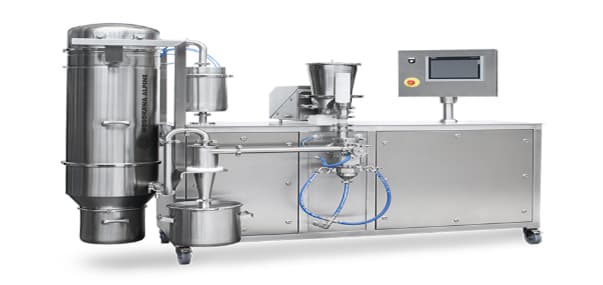
Seven mill types, one system periphery
Product development often calls for switching between mill types, or for incorporating a classifier or classifier mill partway through a process. Running separate standalone systems for each step can slow production and eat up floor space. Hosokawa Alpine’s multi-processing systems address this by housing different mill types within a single mobile system periphery, allowing units to be swapped in and out quickly.
“Our multi-processing systems have proven to be the ideal solution for these requirements in practice,” said Andre Voges, Head of Sales Pharma at Hosokawa Alpine. The platform has so far supported up to seven different mill types on one periphery, and the UPZ 100 III now extends that range further.
Fine grinding from 50 µm to 5 mm
The Ultraplex UPZ 100 III handles particle sizes from 50 µm to 5 mm and processes soft to medium-hard materials up to a Mohs hardness of 3. It can run as a screenless pin mill or as an impact mill fitted with an impact disc, pendulum beaters or plate beaters. A wide-opening mill door feeds material centrally and allows quick tool changes and cleaning, a practical consideration for laboratories handling frequent product changeovers.
Wider applications, food and pharma included
With the UPZ 100 III now built into the multi-processing system, its scope extends from standard grinding tasks to more demanding work involving toxic or potentially explosive materials, and temperature-sensitive raw materials, across the food, chemical and pharmaceutical sectors. The setup supports testing at laboratory and pilot scale, generating data intended to inform later production design. Hosokawa Alpine notes that additional process modules and mill types can be retrofitted later, positioning the system to scale from research and development through pilot trials to full industrial production.
- For more information, visit: hosokawa-alpine.com