
Pulsed electric field pasteurisation offers non-thermal route to safer bovine colostrum
New Zealand researchers demonstrate that pulsed electric field (PEF) processing can achieve pasteurisation-equivalent bacterial reductions in bovine colostrum without the immunoglobulin degradation associated with conventional heat treatment – a finding with direct implications for the growing bovine colostrum supplement sector.
Bovine colostrum has become a sought-after functional food ingredient, prized for its immunoglobulin G (IgG) content and immune-supporting properties. But the very heat treatments used to make it safe for consumption can strip away the bioactivity that makes it valuable in the first place. New research published in Food Innovation and Advances suggests pulsed electric fields (PEF) may resolve this trade-off, achieving microbial reductions comparable to thermal pasteurisation while limiting thermal damage to sensitive proteins.
The study, led by researchers at the University of Otago in collaboration with NIG Nutritionals, is described by its authors as, “the first study to demonstrate the feasibility of PEF as an alternative pasteurization technology for colostrum.” For an industry increasingly reliant on colostrum-derived ingredients, the findings could inform how manufacturers approach processing decisions for heat-labile dairy products.
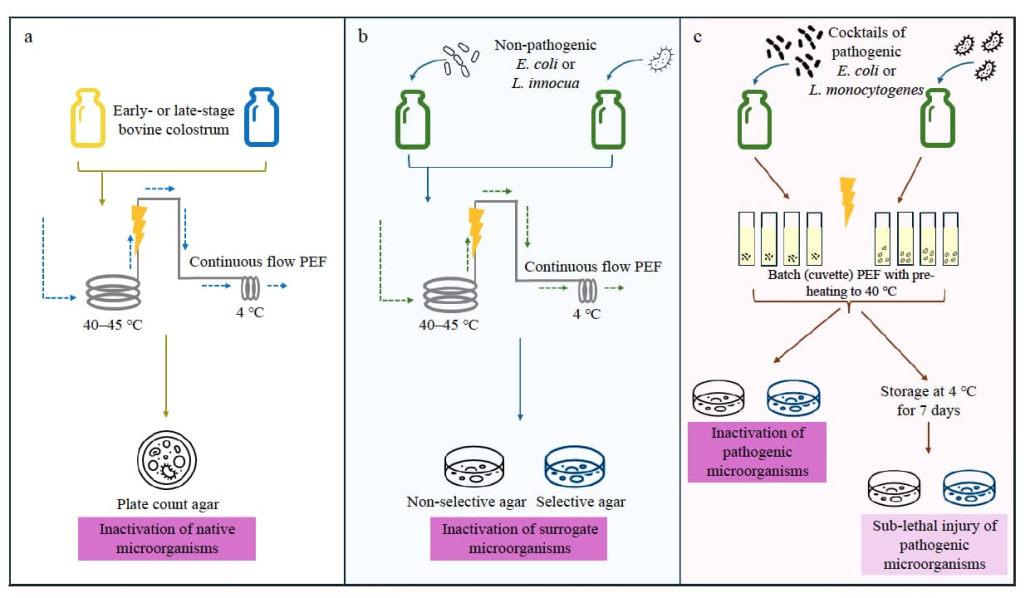
Overview of the three experimental trials conducted in this study. (a) To assess the inactivation of native microorganisms, early- (up to 48 h lactation) and late- (up to 7 d lactation) stage colostrum samples were pre-heated and treated with pulsed electric fields (PEF) in continuous flow before assessing microbial inactivation. (b) Bovine colostrum was inoculated with surrogate microorganisms (E. coli or L. innocua). Colostrum samples were similarly pre-heated prior to continuous flow PEF, and microbial inactivation was assessed via plating on both selective and non-selective agar. (c) Bovine colostrum was inoculated with cocktails of pathogenic microorganisms (E. coli or L. monocytogenes). Due to the pathogenicity of the bacteria, PEF treatment was conducted in batch mode, with colostrum samples contained in cuvettes. Half the PEF-treated samples were assessed immediately for microbial inactivation via plating on selective and non-selective agar, while the other half were assessed following storage for 7 d at 4 °C to assess sublethal injury. © Food Innovation and Advances
Implications for manufacturers
Conventional thermal pasteurisation of milk and colostrum typically ranges from 63°C for 30 minutes up to 135°C for a few seconds, with 72°C for 15 seconds most common for milk processing. These conditions denature IgG, causing aggregation and reduced bioactivity – a well-documented problem for an ingredient category built on immunological claims. The Otago team’s findings indicate that PEF, when combined with mild pre-heating, can deliver equivalent log reductions in bacterial load using significantly less thermal input, a proposition that should interest processors seeking to differentiate premium colostrum products on functional grounds. The authors note that continuous flow PEF, the format most relevant to industrial-scale operations, produced better results than the batch mode used for pathogen trials, “continuous flow PEF is usually favored for bulk pasteurization in industrial settings; thus, the results obtained in this study suggest that moving to industrial-scale colostrum pasteurization should be feasible.”
Three-stage experimental design
The researchers structured their investigation around three trials. The first assessed inactivation of naturally occurring microorganisms in early-stage (within 48 hours of birth) and late-stage (up to seven days) colostrum. Samples pre-heated to 40–45°C and treated with continuous-flow PEF at roughly 13 kV/cm and 229–287 kJ/L achieved close to a five-log reduction in bacterial numbers, with reductions exceeding five logs at the higher pre-heating temperature.
The second trial inoculated colostrum with surrogate non-pathogenic organisms, Escherichia coli ATCC 25922 and Listeria innocua, commonly used stand-ins for foodborne pathogens. Following 40°C pre-heating and PEF treatment at 11 kV/cm and 209 kJ/L, the team recorded a reduction exceeding 6.5 logs in E. coli and over five logs in L. innocua – inactivation broadly comparable to thermal pasteurisation controls run at 62.5°C for 30 minutes.
The third and most demanding trial exposed colostrum inoculated with cocktails of pathogenic E. coli strains and Listeria monocytogenes to batch-mode PEF, conducted in sealed cuvettes for biosafety reasons rather than continuous flow. At field strengths near 8 kV/cm and specific energies up to 184 kJ/kg, the treatment achieved a four-log reduction in pathogenic E. coli and a 2.4-log reduction in L. monocytogenes.
Species sensitivity varies considerably
A recurring theme across the three trials was the differential susceptibility of Gram-negative versus Gram-positive organisms. L. innocua and L. monocytogenes consistently proved more resistant to PEF than E. coli, which the authors attribute to smaller cell size and the protective thick peptidoglycan layer characteristic of Gram-positive bacteria. This variability, the authors argue, carries a caution for how PEF pasteurisation studies are designed. “This highlights the need for careful consideration of the surrogate microorganisms used in PEF pasteurization studies, as selection of PEF-susceptible species could produce misleading results regarding PEF efficacy.”
The press release summarising the work reinforces this point, noting the study demonstrates that pulsed electric field processing can significantly reduce bacterial contamination in colostrum while minimizing heat-induced damage to its functional components.
Sub-lethal injury ruled largely out
To ensure that reported reductions reflected genuine inactivation rather than reversible cell damage, the team compared bacterial counts immediately after treatment against counts following seven days of refrigerated storage. No statistically significant differences emerged at a given specific energy for either pathogen, suggesting the reductions observed were due to inactivation rather than recoverable sub-lethal injury – an important quality-assurance consideration for any processor evaluating PEF as a validated kill-step.
Processing parameters remain product-specific
The study also underscores how sensitive PEF efficacy is to product composition. Early-stage colostrum, despite higher fat content, exhibited lower conductivity than late-stage colostrum, complicating assumptions about the protective effects of fat and protein reported in earlier PEF literature. Conductivity differences between batches – driven by fat, protein and inoculation status – dictated the maximum achievable field strengths and specific energies before flashover occurred, meaning processors will likely need to calibrate PEF settings to specific colostrum batches rather than applying a single standard protocol.
Conclusions and outstanding questions
The authors are careful to frame their results as exploratory rather than definitive. “While PEF appears to be a promising approach for reducing bacterial numbers in colostrum, it is worth noting that other impacts of pasteurization, such as the preservation of growth factors and other heat-labile bioactive compounds, still require further exploration.” They add, however, that “the > 5-log reductions in microbial numbers using pre-heating temperatures of 40–45 °C warrant further exploration of PEF as a viable alternative to thermal pasteurization for bovine colostrum.”
Funding for the work was provided by NIG Nutritionals and Callaghan Innovation.
Reference
King, J., Hardie Boys, M. T., & Pletzer, D., et al. (2026). Pulsed electric fields-mediated inactivation of foodborne pathogens in bovine colostrum. Food Innovation and Advances, 5(1), 45–54. https://doi.org/10.48130/fia-0026-0001